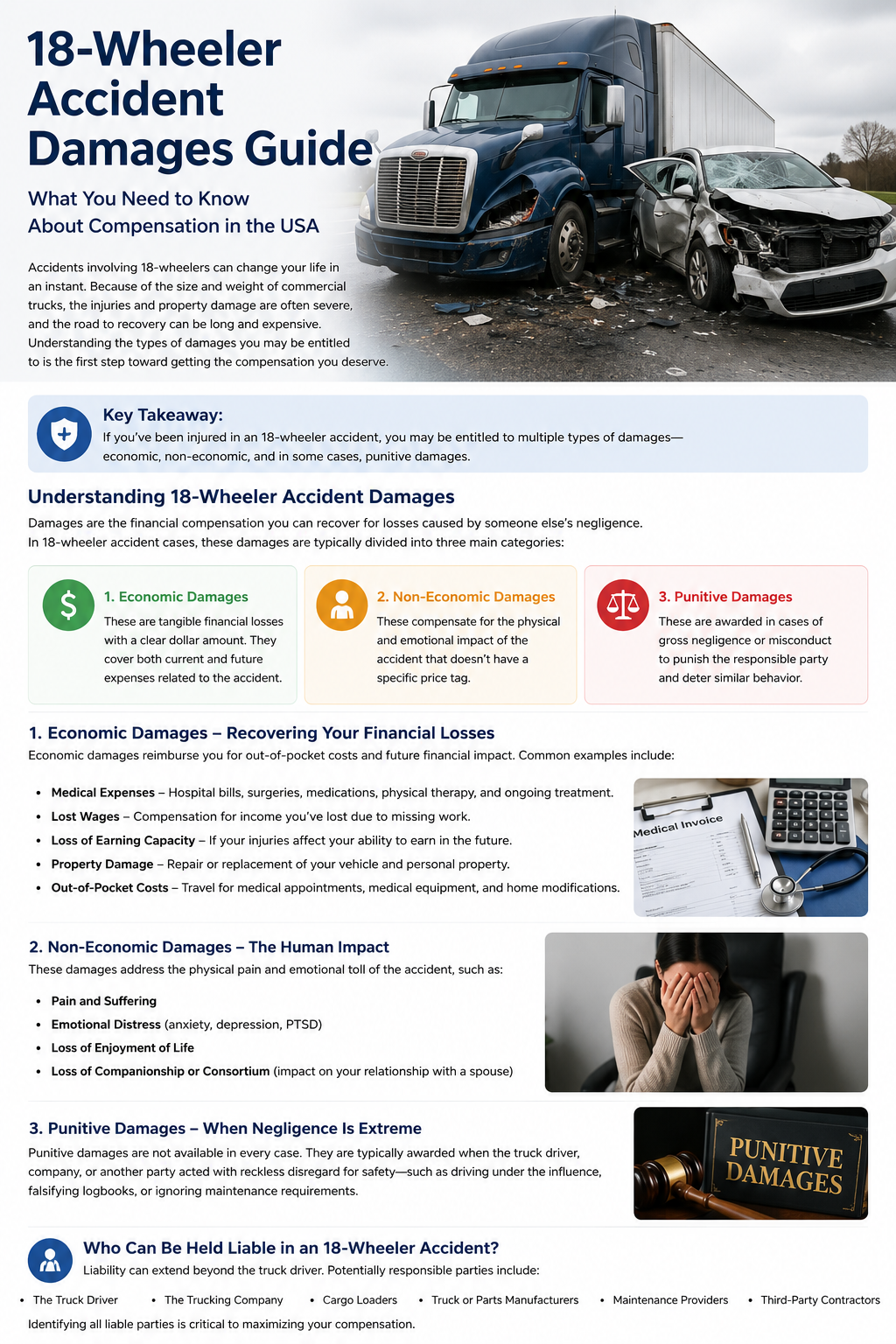
18-Wheeler Accident Damages Guide
An accident involving an 18-wheeler can be very different from an ordinary car accident. Commercial trucks are significantly larger and heavier than passenger vehicles, so a collision can result in serious injuries, extensive vehicle damage, and major financial losses.
If you or someone in your family has been involved in a truck accident, one of the first questions you may have is:
“What damages can I recover after an 18-wheeler accident?”
The answer depends on several factors, including the severity of your injuries, who was responsible for the crash, your financial losses, the state where the accident happened, and whether your injuries will affect your future.
This 18-Wheeler Accident Damages Guide explains the major types of compensation that may be available after a serious truck accident in the United States.
Important: Truck accident laws and damage rules vary by state. This article provides general information and is not a substitute for advice from a qualified attorney.
What Are 18-Wheeler Accident Damages?

In a personal injury claim, damages generally refer to monetary compensation for losses caused by another party’s negligence or wrongful conduct.
After an 18-wheeler crash, damages may include both financial losses that are relatively easy to calculate and losses that are more difficult to put into a dollar amount.
Generally, compensation may fall into three broad categories:
- Economic damages
- Non-economic damages
- Punitive damages, in certain cases
The exact damages available depend on the facts of the accident and applicable state law.
1. Economic Damages After an 18-Wheeler Accident
Economic damages are losses that have a measurable financial value.
These damages are often supported by documents such as medical bills, pay stubs, repair estimates, invoices, and other financial records.
Medical Expenses
Medical treatment can become one of the largest costs after a serious truck accident.
Depending on the injuries, medical expenses may include:
- Emergency room treatment
- Ambulance transportation
- Hospital stays
- Surgery
- Prescription medications
- Diagnostic testing
- Physical therapy
- Rehabilitation
- Follow-up appointments
- Medical equipment
- Future medical treatment
If an injury requires long-term care, calculating future medical expenses can become particularly important.
Lost Wages

If your injuries prevent you from working, you may be able to seek compensation for income lost because of the accident.
For example, you may lose income because you:
- Missed several weeks of work
- Used paid or unpaid leave
- Could not return to your normal job duties
- Had to reduce your working hours
Documentation such as pay records and employer statements may help establish these losses.
Loss of Future Earning Capacity
Some truck accident injuries can affect a person’s ability to earn money for years.
For example, a construction worker who suffers a permanent physical injury may no longer be able to perform the same job.
In situations like this, a claim may potentially include damages for reduced future earning capacity.
The calculation can involve factors such as:
- Age
- Occupation
- Income history
- Education and skills
- Severity of the injury
- Expected future earnings
- Ability to perform similar work
Because these calculations can be complicated, expert economic or vocational evidence may sometimes be used.
2. Property Damage
An 18-wheeler collision can completely destroy a passenger vehicle.
Property-related losses may include:
- Vehicle repairs
- Vehicle replacement
- Towing expenses
- Rental transportation
- Damage to personal belongings inside the vehicle
Keep photographs of the damaged vehicle and preserve repair estimates, insurance documents, towing receipts, and other related records.
3. Pain and Suffering
Not every loss has a simple receipt attached to it.
Pain and suffering damages may compensate for the physical pain and discomfort caused by an accident and its injuries.
For example, someone recovering from multiple fractures, spinal injuries, or extensive surgery may experience substantial physical suffering during recovery.
The amount isn’t determined by a universal formula that applies to every 18-wheeler accident. The facts of the individual case matter.
4. Emotional Distress
A serious truck accident can affect a person’s emotional well-being as well as their physical health.
Some accident victims experience:
- Anxiety
- Fear of driving
- Sleep problems
- Emotional distress
- Depression
- Trauma-related symptoms
If emotional injuries are part of a claim, medical or psychological records may help establish their seriousness.
5. Loss of Enjoyment of Life

An injury can prevent someone from doing activities they enjoyed before the accident.
For example, an injured person might no longer be able to:
- Play sports
- Exercise
- Travel
- Spend time with family
- Participate in hobbies
- Perform everyday activities independently
In appropriate cases, these losses may be considered as part of non-economic damages.
6. Loss of Consortium
Depending on state law and the circumstances, a spouse may have a claim related to the effect of serious injuries on the marital relationship.
This can involve issues such as loss of companionship, affection, or support.
Because consortium laws differ significantly between states, an attorney can explain whether such a claim is available in the jurisdiction involved.
Can You Receive Punitive Damages After an 18-Wheeler Accident?
Punitive damages are different from ordinary compensation.
Their purpose is generally to punish particularly egregious conduct and deter similar behavior—not simply to reimburse an injured person for their losses.
They are not automatically available after a truck accident.
Depending on state law, potentially relevant conduct could include extremely reckless or intentional behavior. Examples might involve serious safety violations or knowingly dangerous conduct, but whether punitive damages are possible depends on the specific facts and applicable law.
Who May Be Responsible for 18-Wheeler Accident Damages?

One of the more complicated parts of a commercial truck accident case is determining who is legally responsible.
The truck driver isn’t necessarily the only potentially liable party.
Depending on the circumstances, an investigation may examine:
Truck Driver
A driver may potentially be responsible if the crash resulted from negligent conduct such as:
- Distracted driving
- Speeding
- Fatigued driving
- Impaired driving
- Unsafe lane changes
- Following too closely
Trucking Company
The trucking company may potentially face liability depending on its relationship with the driver and the facts of the accident.
Investigators may examine issues involving:
- Driver hiring
- Training
- Supervision
- Scheduling
- Vehicle maintenance
- Company safety practices
Truck or Parts Manufacturer
If a defective component contributed to the collision, product liability may become an issue.
Potential examples include problems involving:
- Brakes
- Tires
- Steering components
- Other critical truck parts
Maintenance Company
Commercial trucks require regular inspection and maintenance.
If negligent maintenance contributed to the accident, the responsible maintenance provider could potentially become part of the claim.
Cargo Loading Company
Improperly loaded or unsecured cargo can create serious safety risks.
An investigation may therefore examine who loaded, secured, or inspected the cargo.
How Are 18-Wheeler Accident Damages Calculated?
There isn’t one universal settlement calculator that accurately determines what every truck accident case is worth.
Insurance companies and attorneys may consider numerous factors, including:
Medical losses + lost income + future financial losses + property damage + non-economic damages + other legally recoverable losses
The value of a case can depend heavily on the severity and permanence of the injuries.
For example, a minor soft-tissue injury and a permanent spinal injury are obviously very different situations.
Other factors may include:
- Clear evidence of liability
- Insurance coverage
- Number of liable parties
- Severity of injuries
- Length of recovery
- Future medical needs
- Permanent disability
- Impact on employment
- Evidence supporting the claim
- Applicable state law
What Evidence Can Help Prove Your Damages?
Strong documentation can make a significant difference when establishing accident-related losses.
Consider preserving:
- Police accident reports
- Medical records
- Medical bills
- Prescription receipts
- Pay stubs
- Tax records
- Employer documentation
- Vehicle repair estimates
- Photographs of the crash
- Photographs of injuries
- Witness contact information
- Insurance correspondence
- Accident-related expenses
In commercial truck cases, evidence from the trucking operation may also become important, depending on the circumstances.
Why 18-Wheeler Accident Cases Can Be Complicated
Truck accident claims can involve more than two drivers and two insurance companies.
There may be:
- Commercial trucking companies
- Multiple insurers
- Truck owners
- Drivers
- Cargo companies
- Maintenance providers
- Manufacturers
- Contractors
There may also be important evidence that needs to be identified and preserved quickly.
That’s one reason people with significant injuries often consider speaking with an experienced truck accident attorney before accepting a settlement.
What Should You Do After an 18-Wheeler Accident?
If you’re physically able to do so after a crash, consider taking these steps:
1. Get Medical Attention
Some injuries aren’t immediately obvious after a collision. Follow appropriate medical advice and keep records of your treatment.
2. Report the Accident
Make sure the accident is properly reported to the appropriate authorities.
3. Document the Scene
If it is safe, take photographs or videos of:
- Vehicles
- Road conditions
- Traffic signs
- Visible injuries
- Property damage
- Surrounding areas
4. Collect Witness Information
Names and contact information of witnesses may become useful later.
5. Be Careful With Insurance Statements
You should cooperate with legitimate insurance processes, but avoid guessing about facts or making statements that could unintentionally hurt your claim.
6. Preserve Your Records
Keep medical bills, receipts, employment records, repair estimates, and other accident-related documents in one place.
7. Consider Legal Advice
If the accident caused serious injuries, permanent disability, significant property damage, or a death, consulting a qualified attorney may help you understand your legal options.
How Long Do You Have to File an 18-Wheeler Accident Claim?
Every state has its own statute of limitations, which sets deadlines for filing certain legal claims.
The deadline can also vary depending on factors such as:
- Type of claim
- State involved
- Government involvement
- Age of the injured person
- Wrongful death
- Other special circumstances
Because missing a legal deadline can seriously affect your ability to pursue a claim, it’s important to determine the applicable deadline as early as possible.
How Much Is an 18-Wheeler Accident Settlement Worth?
This is one of the most common questions accident victims ask, but there is no reliable single number.
Two people involved in seemingly similar truck crashes can have completely different outcomes.
For example, one person may recover quickly and return to work, while another may require surgery, rehabilitation, and lifelong care.
The potential value of a claim may depend on:
Severity of injury → Medical expenses → Lost income → Future losses → Pain and suffering → Liability → Insurance coverage → State law
Be skeptical of websites promising a guaranteed settlement amount based only on the type of accident.
Should You Accept the Insurance Company’s First Settlement Offer?
Not necessarily.
An initial settlement offer may be based on the information the insurer currently has about your losses. If your medical treatment or future needs are not fully understood, accepting an offer too quickly could potentially leave you responsible for future expenses.
Before signing a settlement agreement, understand:
- What expenses are covered
- Whether future medical costs are included
- Whether lost income is included
- Whether the settlement releases additional claims
- What your state’s law allows
For a serious injury claim, professional legal advice can be particularly valuable before signing a final release.
Frequently Asked Questions About 18-Wheeler Accident Damages
What damages can I claim after an 18-wheeler accident?
Depending on the circumstances and state law, damages may include medical expenses, lost wages, future earning losses, property damage, pain and suffering, emotional distress, loss of enjoyment of life, and potentially punitive damages in qualifying cases.
Are 18-wheeler accident settlements usually higher than car accident settlements?
Not automatically. However, truck crashes can involve severe injuries and significant losses because of the size and weight of commercial vehicles. The value of an individual claim depends on its specific facts.
Can I sue the trucking company after an accident?
Potentially. Whether a trucking company can be held liable depends on the driver’s relationship with the company, the company’s conduct, applicable law, and the circumstances of the crash.
What if the truck driver was at fault?
A driver’s negligence can potentially create liability, but other parties may also be responsible depending on the evidence.
Can I recover damages for future medical treatment?
Potentially, if the applicable law allows it and there is sufficient evidence establishing the need and expected cost of future treatment.
Do I need a lawyer after an 18-wheeler accident?
You aren’t automatically required to hire an attorney. However, if you suffered serious injuries, permanent disability, substantial financial losses, or the accident involves multiple potentially responsible parties, speaking with an experienced truck accident lawyer can help you understand your options.
Final Thoughts: Understanding Your 18-Wheeler Accident Damages
An 18-wheeler accident can create much more than immediate vehicle damage. Medical treatment, missed work, long-term disability, emotional suffering, and future financial losses can affect your life for years.
Understanding the different types of 18-wheeler accident damages is an important first step.
If you’ve been seriously injured, focus first on getting appropriate medical care and preserving important evidence and records. Then consider getting advice from a qualified attorney who understands the truck accident laws in your state.
The sooner you understand your rights and potential losses, the better positioned you may be to make an informed decision about your claim.