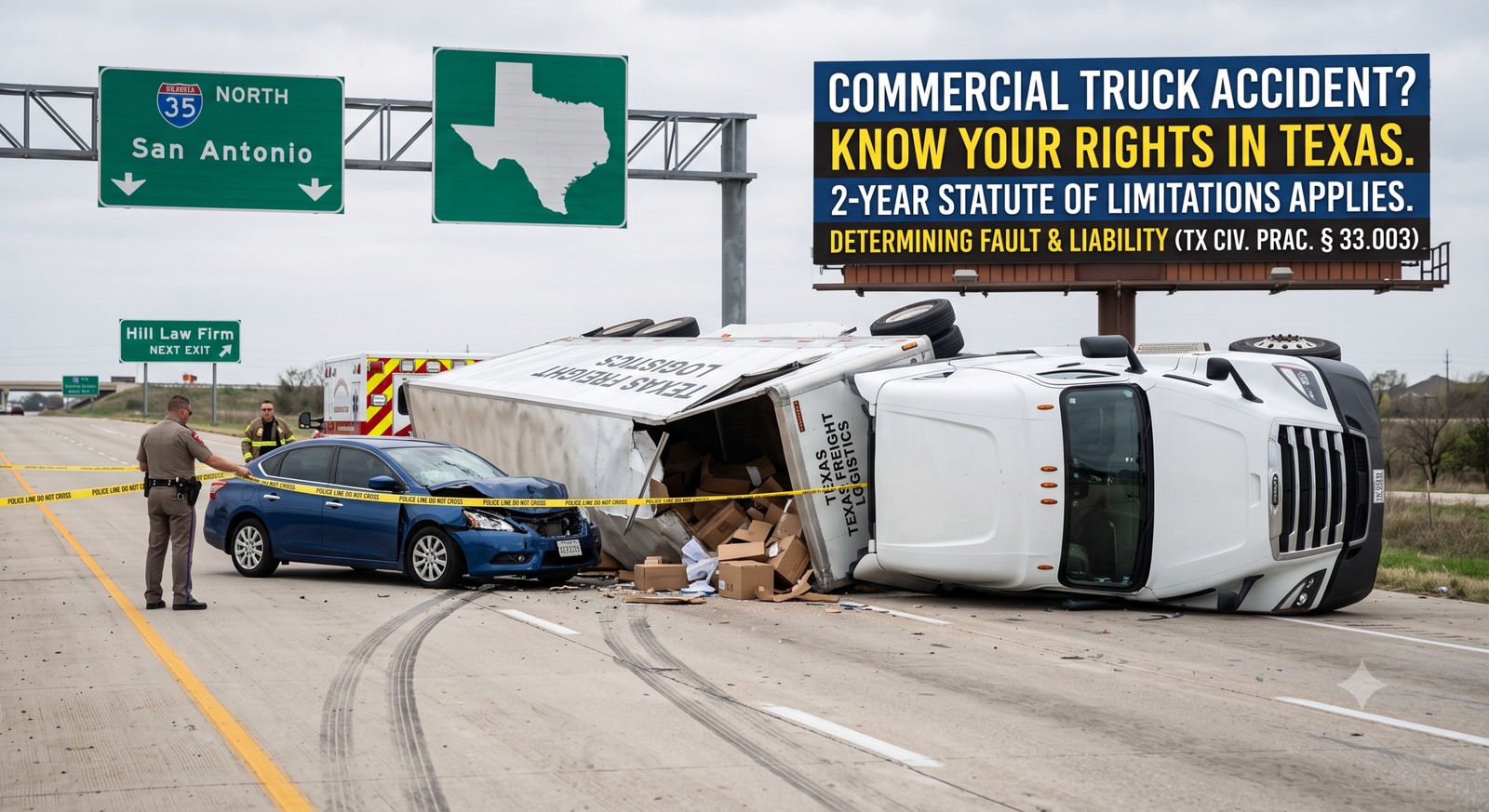
Navigating the aftermath of a catastrophic highway crash requires working with an experienced commercial semi truck rollover lawyer Texas claimants rely on to hold multi-million-dollar motor carriers accountable. Commercial rollover wrecks across key freight corridors—including I-10, I-35, and the Permian Basin—cause severe traumatic injuries and complex corporate disputes. Because Texas applies distinct liability frameworks and strict evidentiary thresholds to commercial motor vehicles, recovering maximum compensation demands a deep understanding of state civil codes and federal safety mandates.
Understanding Commercial Semi Truck Rollover Accidents in Texas
A semi-truck rollover occurs when a tractor-trailer’s center of gravity shifts past its stability threshold, causing the vehicle to tip onto its side or roof. Unlike standard passenger vehicle collisions, commercial rollovers involve massive momentum, 80,000-pound gross vehicle weights, and hazardous cargo spills.
Under Chapter 33 of the Texas Civil Practice and Remedies Code, Texas operates under a proportionate responsibility (modified comparative fault) system. An injured plaintiff can recover financial damages as long as their share of fault does not exceed 50%. If the court assigns you 10% of the fault, your recovery is reduced by 10%. If you are determined to be 51% or more responsible, Texas law bars you from any financial recovery. Trucking insurers frequently exploit this rule to shift blame onto passenger car drivers, making thorough accident reconstruction vital.
Common Causes of Semi Rollovers on Texas Highways
Rollover crashes rarely happen by chance. They are almost always the product of regulatory non-compliance, mechanical neglect, or driver error:
- Unbalanced or Unsecured Freight: Improperly balanced cargo can cause the trailer to list during turns, triggering an irrecoverable centrifugal pull.
- Excessive Speed for Road Conditions: Taking highway interchanges, cloverleafs, or curved ramps at speeds above the trailer’s rollover threshold.
- Driver Fatigue and Hours-of-Service (HOS) Violations: Exhaustion impairs reaction time, leading to abrupt oversteering or drift-and-jerk maneuvers that overturn tall trailers.
- Mechanical and Brake Failures: Defective steer axle assemblies, out-of-adjustment S-cam drum brakes, or sudden tire blowouts.
- Liquid Slosh Dynamics: In liquid tankers, liquid surges inside partially filled baffles create uneven dynamic forces that destabilize the chassis.
Liable Parties in a Texas Commercial Truck Rollover Lawsuit
Personal injury claims involving commercial tractor-trailers go well beyond individual drivers. Depending on the supply chain structure, several corporate entities may share liability:
| Liable Party | Basis of Legal Liability | Relevant Governing Regulations |
|---|---|---|
| Commercial Driver | Speeding, distracted driving, sudden overcorrection, driving over HOS limits | 49 CFR Part 392 (Driving Rules), Texas Transp. Code |
| Motor Carrier / Trucking Co. | Negligent hiring, improper safety vetting, forced delivery timelines | 49 CFR Part 391 (Driver Qualifications), Part 385 |
| Cargo Loading Facility / Shippers | Overloading axle weights, failure to strap/block/brace pallets | 49 CFR Part 393, Subpart I (Cargo Securement) |
| Third-Party Maintenance Shop | Falsified safety inspections, failure to replace worn brake pads/tires | 49 CFR Part 396 (Inspection, Repair & Maintenance) |
| Component Manufacturer | Defective fifth-wheel coupling, faulty tires, or steering gear assemblies | Texas Strict Product Liability Law |
The Impact of Texas House Bill 19 (HB 19) on Truck Lawsuits
Claimants filing suit in Texas must navigate Texas Civil Practice and Remedies Code § 72.051–72.054 (enacted under HB 19). This law created a bifurcated trial process for commercial motor vehicle accidents:
- Phase 1 (Driver Negligence & Compensatory Damages): The jury evaluates the immediate actions of the truck driver to establish who caused the collision, along with actual damages (medical bills, lost wages, pain and suffering). Under § 72.054, if the employer stipulates that the driver was within their scope of employment, the court may restrict the jury from reviewing the company’s past safety track record in this initial phase.
- Phase 2 (Employer Liability & Exemplary Damages): Only if the driver is found liable in Phase 1—or if specific corporate negligent entrustment exceptions apply—does the case move to Phase 2. Here, evidence of systemic company violations, inadequate background screenings, and gross negligence is presented to pursue punitive (exemplary) damages.
Handling a bifurcated trial demands aggressive, structured preparation from day one so that liability is indisputably locked in during Phase 1.
Critical Telematics & Black Box Evidence to Preserve
Motor carriers have commercial defense teams on the scene within hours of a rollover. Preserving digital and physical evidence through a formal Spoliation Letter is the most urgent initial step:
- Engine Control Module (ECM / Black Box): Records vehicle speed, percent throttle, engine RPM, clutch application, steering wheel angles, and hard-braking events in the seconds surrounding the impact.
- Electronic Logging Device (ELD) Records: Federal law (49 CFR § 395.8) mandates automated recording of driving duty hours. ELDs help detect forged log entries and illegal drive time.
- Onboard Video & Telematics: Forward-facing and cab-facing video feeds, lane-departure logs, and stability control event logs.
- Driver Qualification File (DQF): Required under 49 CFR § 391.51, this file holds background checks, road test certifications, and medical examiner certificates.
- Maintenance & DVIR Reports: Driver Vehicle Inspection Reports (DVIRs) reveal if the driver ignored pre-trip mechanical red flags before taking the highway.
Calculating Damages in a Texas Truck Rollover Claim
Because rollover accidents often result in traumatic brain injuries (TBI), compound fractures, severe burns, or spinal cord paralysis, settlement and trial amounts are significantly higher than everyday auto claims:
- Economic Damages: Past and future hospital costs, specialized surgeries, vocational rehabilitation, home accessibility modifications, and diminished future earning power.
- Non-Economic Damages: Physical pain, permanent physical impairment, loss of consortium, and post-traumatic stress disorder (PTSD).
- Wrongful Death & Survival Claims: Under Tex. Civ. Prac. & Rem. Code §§ 71.002 and 71.021, surviving spouses, children, and parents can recover burial expenses, lost future financial support, and mental anguish.
Check This :- Commercial truck accident settlement calculator
Texas Statute of Limitations for Truck Accidents
Under Texas Civil Practice and Remedies Code § 16.003, the statute of limitations for personal injury and wrongful death lawsuits is two years from the date the accident occurred.
Failing to file a lawsuit before this two-year deadline permanently bars you from seeking damages in court. Furthermore, relying on that two-year window without taking immediate legal action can be detrimental: electronic black box loops are frequently overwritten within 30 to 90 days, damaged commercial equipment is quickly scrapped, and physical skid marks fade.
Frequently Asked Questions
How much does hiring a truck rollover attorney in Texas cost?
Most commercial vehicle accident attorneys represent victims on a contingency fee basis. Clients pay no upfront retainers or out-of-pocket hourly rates; legal fees are deducted as an agreed percentage only after successfully securing a settlement or court award.
Can I sue the trucking company if the driver was an independent contractor?
Yes. Under Federal Motor Carrier Safety Administration (FMCSA) regulations, motor carriers holding USDOT operating authority generally cannot shield themselves by classifying drivers as independent contractors (statutory employee doctrine). If the truck operated under the carrier’s DOT authority, the carrier can be held legally accountable.
What is the average settlement for a commercial truck rollover in Texas?
There is no uniform “average” settlement. Values depend heavily on available insurance policy limits (commercial trucks typically carry policies ranging from $750,000 to $5,000,000+), the severity of permanent medical impairment, comparative fault percentages, and proof of gross corporate negligence.