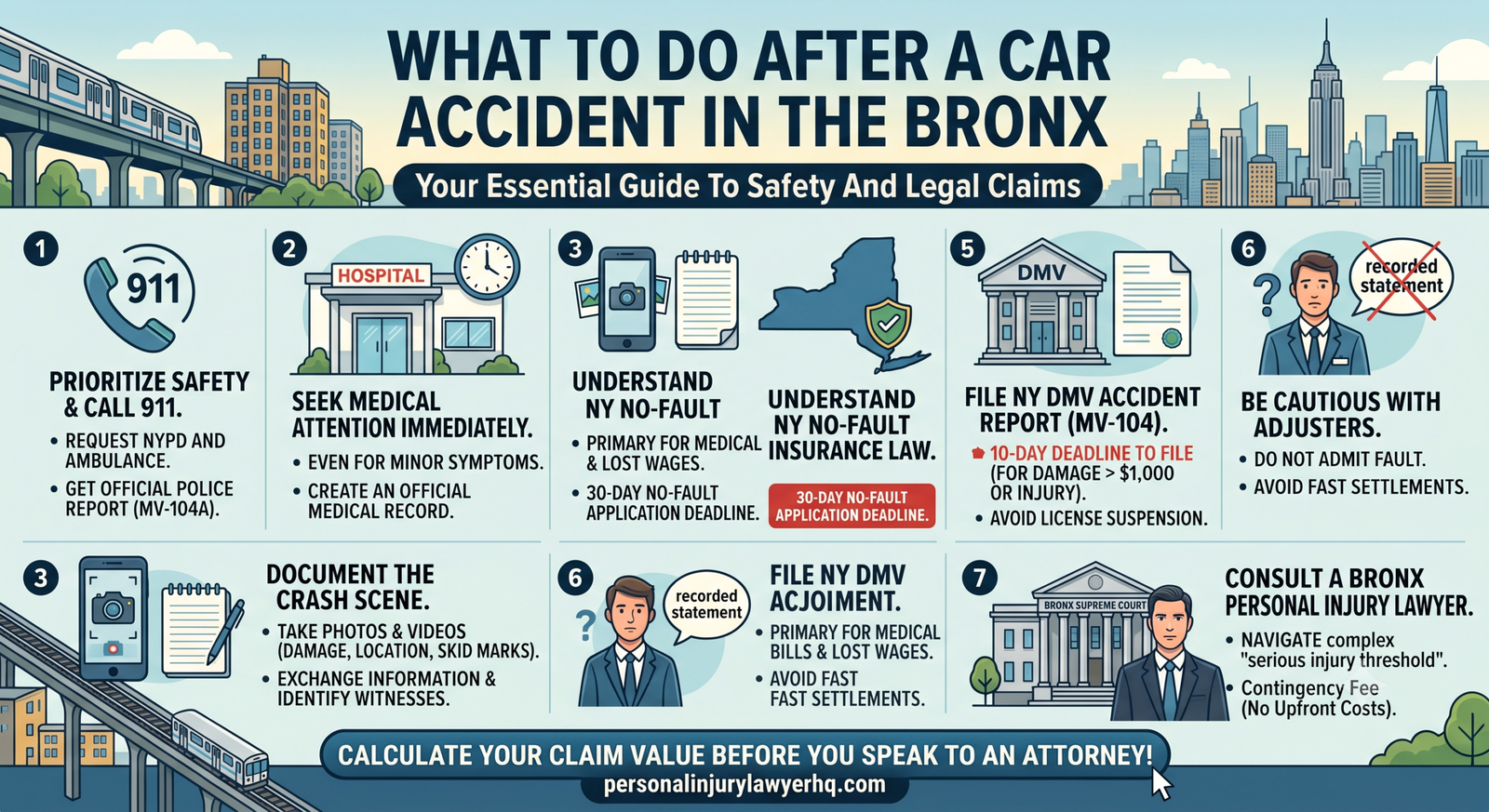
Navigating the aftermath of a collision on the Cross Bronx Expressway, Fordham Road, or any busy intersection in the borough can be overwhelming. Between the chaotic traffic, adrenaline, and potential injuries, it is easy to make a mistake that could jeopardize your health and your legal rights.
If you are wondering what to do after a car accident in the Bronx, you must act quickly to comply with New York state laws and protect your right to compensation. This step-by-step guide covers everything from handling the NYPD to meeting critical insurance deadlines.
1. Prioritize Safety and Call 911
Your immediate priority is safety. If your vehicle is drivable and is causing a hazard in the middle of a busy Bronx intersection, move it to the shoulder or side of the road if possible. Turn on your hazard lights.
Always call 911 immediately, even for a minor fender bender. Request an ambulance if anyone feels pain. When the NYPD arrives (whether from the 44th, 46th, or any other local precinct), they will document the scene and create a formal Police Accident Report (MV-104A). Do not leave the scene before the police arrive, as leaving the scene of an accident involving property damage or injury is a crime in New York.
Was a Commercial Vehicle Involved? If your accident involved an 18-wheeler or commercial truck, the rules change drastically due to federal regulations. Learn more in ourTexas Commercial Truck Rollover Guide(Note: While this guide focuses on Texas, the FMCSA federal regulations and black box data preservation tactics apply nationwide, including in New York).
2. Seek Medical Attention Immediately
Never assume you are “fine” just because you don’t feel immediate pain. Adrenaline often masks the symptoms of serious conditions like whiplash, concussions, or internal bleeding.
Visit a local emergency room—such as BronxCare Health System, Jacobi Medical Center, or Montefiore—or an urgent care clinic on the same day. Seeking prompt medical care not only protects your health but also creates a crucial official medical record linking your injuries directly to the collision.
3. Document the Crash Scene
While waiting for the police, and only if it is safe to do so, start gathering evidence. The Bronx is crowded, and witnesses can disappear quickly.
- Take Photos and Videos: Capture the damage to all vehicles, license plates, the exact location (including street signs or nearby landmarks), and skid marks on the road.
- Exchange Information: Get the other driver’s name, contact details, insurance company, policy number, and driver’s license number.
- Identify Witnesses: Ask anyone who saw the crash for their name and phone number. Independent witness statements are highly valuable if the other driver disputes who was at fault.
4. Understand New York’s No-Fault Insurance Law
New York is a “no-fault” car insurance state. This means that regardless of who caused the accident, your own auto insurance (or the insurance of the car you were riding in) is primarily responsible for covering your medical bills and lost wages.
Critical Deadline: To receive these benefits, you must file a No-Fault Application (Form NF-2) with the correct insurance company within 30 days of the accident. Missing this 30-day window can result in an absolute denial of your medical and wage loss claims.
5. File the NY DMV Accident Report (MV-104)
The police report is not the only paperwork you need to worry about. Under New York State law, if the accident caused an injury, a fatality, or property damage exceeding $1,000, you are legally required to file a Report of Motor Vehicle Accident (Form MV-104) with the Department of Motor Vehicles (DMV).
Critical Deadline: You must file the MV-104 within 10 days of the crash. Failing to do so can result in the suspension of your driver’s license.
6. Be Cautious with Insurance Adjusters (And Know Your Claim Value)
Shortly after the crash, the other driver’s insurance company may call you. Their goal is often to minimize their financial payout.
- Do not provide a recorded statement.
- Do not admit fault or apologize.
- Do not accept a fast settlement offer, as it is likely far lower than what you need to cover future medical expenses and pain and suffering.
Before you speak to an adjuster, you need to know what your claim might actually be worth. Use our free, interactiveCar Accident Settlement Estimatorto calculate your potential economic and non-economic damages using real insurance formulas.
7. Consult a Bronx Personal Injury Lawyer
Navigating New York’s complex “serious injury threshold” (Insurance Law § 5102(d)) requires legal expertise. If your injuries qualify as “serious” under state law, you can step outside the no-fault system and pursue a personal injury lawsuit against the at-fault driver for pain and suffering.
In New York, the statute of limitations to file a personal injury lawsuit is generally three years from the date of the accident. However, if a city vehicle (like an MTA bus or NYC sanitation truck) was involved, you have only 90 days to file a Notice of Claim. A local Bronx auto accident attorney will ensure you don’t miss these rigid deadlines and will fight for maximum compensation.
(If your accident was complicated by external factors—such as a confrontation with an aggressive driver or an unsafe property condition—you might also want to review our Assault Injury Civil Recovery Guide to understand third-party liability).
FAQ: Bronx Car Accidents
Do I have to call the police for a minor car accident in the Bronx? Yes. If there is more than $1,000 in property damage or any physical injury, it must be reported. Having an official NYPD report is also critical for your insurance claim, even for minor damage.
Can I still get compensation if I was partially at fault? Yes. New York follows a “pure comparative negligence” rule. You can still recover damages even if you were partially to blame, but your total compensation will be reduced by your percentage of fault.
How much does a Bronx personal injury lawyer cost? Almost all personal injury law firms in the Bronx work on a contingency fee basis. This means you pay zero upfront costs, and the lawyer only gets paid a percentage of the settlement or verdict if they win your case.