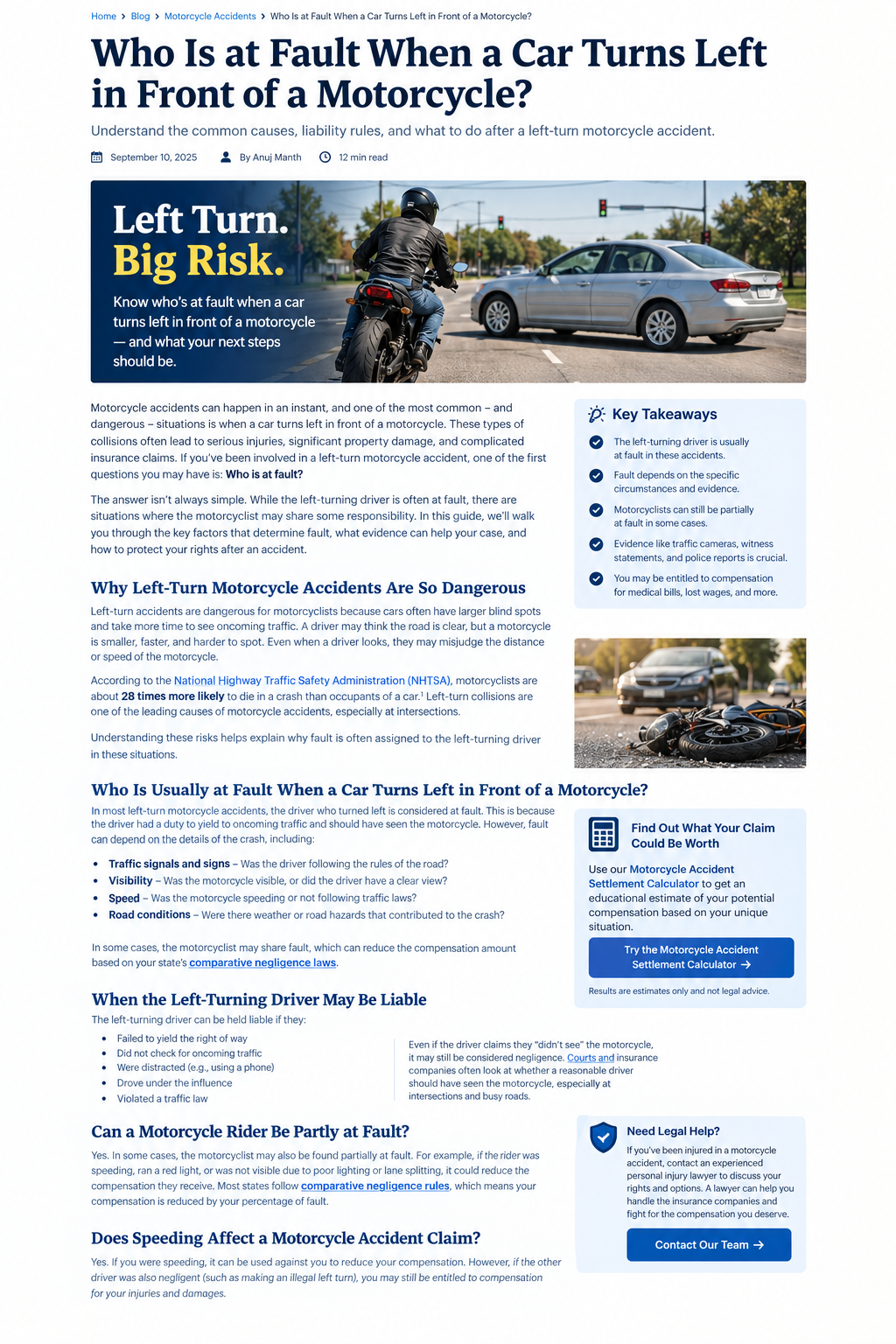
Who is at fault when a car turns left in front of a motorcycle? In many left-turn motorcycle accidents, the driver making the left turn may be responsible if the driver failed to yield to an approaching motorcycle that had the right of way. However, fault is not automatic in every crash. Traffic signals, vehicle speed, road conditions, visibility, witness statements, video footage, and the actions of both drivers can affect how liability is determined.
A car turning left across the path of an approaching motorcycle can create a serious collision, particularly at intersections. Because motorcycles are smaller and less visible than passenger vehicles, these crashes can result in severe injuries.
If you or someone you know was injured in this type of collision, understanding who is at fault when a car turns left in front of a motorcycle can help you understand the factors that may affect an insurance claim or potential personal injury case.
Important: This article provides general educational information and is not legal advice. Motorcycle accident laws and comparative-fault rules vary by state.
Who Is Usually at Fault When a Car Turns Left in Front of a Motorcycle?
In a typical left-turn collision, the driver turning left may be at fault if the driver failed to yield to an approaching motorcycle that had the right of way.
For example, imagine a motorcycle is traveling straight through an intersection. A vehicle coming from the opposite direction begins making a left turn across the motorcycle’s lane. The motorcycle continues forward and crashes into the side of the vehicle.
If the motorcycle had the right of way and the car driver turned without ensuring the intersection was clear, the car driver could potentially be responsible for the collision.
However, investigators will normally look at the entire accident rather than automatically blaming one driver.
Important questions can include:
- Was the motorcycle traveling within the speed limit?
- Did the motorcycle have a green light?
- Did the driver have a protected left-turn signal?
- Was the motorcycle visible to the driver?
- Did either driver run a red light?
- Was either driver distracted?
- Did the motorcycle suddenly change lanes?
- Were there witnesses?
- Was there video from a traffic camera or nearby business?
- Did weather or road conditions affect visibility?
The answers to these questions can significantly affect liability.
Why Left-Turn Motorcycle Accidents Are So Dangerous
A motorcycle is considerably smaller and less visible than a passenger vehicle. This can make it more difficult for drivers to recognize an approaching motorcycle, particularly at intersections.
A driver may look toward oncoming traffic but fail to properly identify a motorcycle before beginning a turn.
This can create a situation sometimes described as a motorcycle being “looked at but not seen.”
The consequences can be severe because motorcycles provide much less physical protection than passenger vehicles.
A collision may result in:
- Broken bones
- Road rash
- Shoulder injuries
- Knee injuries
- Spinal injuries
- Traumatic brain injuries
- Internal injuries
- Permanent disability
- Emotional distress
- Long-term rehabilitation
The seriousness of the resulting injuries can become an important factor when evaluating a potential personal injury claim.
When Does the Turning Driver Have a Duty to Yield?
Traffic laws differ by state, but drivers generally must follow traffic-control devices and yield when required before turning across the path of oncoming traffic.
A driver making a left turn should normally make sure that the movement can be completed safely.
For example, if a motorcycle is approaching an intersection and has the right of way, a vehicle turning left generally cannot simply enter the motorcycle’s path because the driver believes there is enough time.
A failure to yield can become evidence of negligence.
However, the exact legal standard depends on the state where the crash occurred.
What If the Motorcycle Was Speeding?
Speed can complicate an otherwise straightforward left-turn accident.
Suppose a car begins making a legal left turn while a motorcycle is approaching from the opposite direction. If the motorcycle was traveling significantly above the speed limit, investigators may examine whether the excessive speed contributed to the crash.
This does not necessarily mean the motorcycle rider automatically becomes responsible.
Instead, the issue may become one of comparative fault.
For example, depending on state law and the evidence, both parties could potentially share responsibility:
- Car driver: 70% fault
- Motorcycle rider: 30% fault
If the motorcycle rider’s damages were $100,000, a 30% reduction could potentially leave $70,000 in recoverable damages under a system that applies that type of comparative-fault rule.
This is only a mathematical illustration. Actual compensation depends on the applicable state’s law and the facts of the accident.
What If the Car Had a Green Arrow?
A protected left-turn arrow can substantially change the analysis.
If the car driver had a green protected left-turn arrow and the motorcycle had a red light, the motorcycle rider may potentially be responsible.
But traffic signals can sometimes create complicated situations.
Investigators may need to determine:
- Which vehicle had the green signal?
- Was the signal functioning correctly?
- Did one driver enter the intersection after the light changed?
- Was there a protected turn arrow?
- Did either driver turn against a red signal?
- Are there traffic-camera recordings?
Traffic-camera footage can be especially valuable when drivers give conflicting versions of what happened.
What If Both Vehicles Had a Green Light?
A common situation occurs when a motorcycle and a car approaching from opposite directions both have green lights.
A green light does not necessarily mean that a driver can make a left turn without yielding to approaching traffic.
The turning driver may still have to yield depending on the traffic-control setup and applicable state law.
For example:
Motorcycle: traveling straight through the intersection.
Car: traveling in the opposite direction and attempting a left turn.
If both have ordinary green lights, the driver turning left may still need to wait until the oncoming motorcycle has passed.
This is why the specific traffic signal and intersection design matter.
Evidence That Can Help Determine Fault
Evidence can be extremely important after a motorcycle accident.
1. Police Report
The police report may contain:
- Statements from drivers
- Witness information
- Traffic citations
- Road conditions
- Officer observations
- Diagrams
- Insurance information
A police report is useful evidence, although it does not necessarily determine the final legal outcome.
2. Accident Scene Photographs
Photographs can show:
- Vehicle positions
- Motorcycle damage
- Car damage
- Skid marks
- Traffic signs
- Traffic lights
- Road markings
- Visibility conditions
- Debris
Take photographs as soon as it is reasonably safe to do so.
3. Witness Statements
Independent witnesses can be particularly valuable when the drivers disagree about who had the right of way.
A witness may have seen:
- The motorcycle’s direction of travel
- The car beginning its turn
- The traffic signal
- The speed of either vehicle
- Whether the driver appeared distracted
4. Traffic and Security Cameras
Some intersections have traffic cameras. Businesses, homes, gas stations, and other properties near the crash may also have surveillance footage.
Because recordings may be overwritten, identifying potential video sources quickly can be important.
5. Vehicle Damage
The location and severity of vehicle damage can help accident investigators reconstruct what happened.
For example, damage to the front of a motorcycle and the side of a turning vehicle may support a particular collision sequence.
Damage alone, however, does not automatically establish legal fault.
6. Medical Records
Medical records help document the injuries resulting from the crash.
They may establish:
- Diagnosis
- Treatment
- Surgery
- Rehabilitation
- Medication
- Future medical needs
- Physical limitations
Medical documentation can become important when evaluating damages.
What Damages Can a Motorcycle Accident Victim Potentially Recover?
If another driver is legally responsible, an injured motorcycle rider may potentially seek compensation for damages allowed under applicable state law.
Possible damages can include:
- Emergency medical treatment
- Hospital bills
- Surgery
- Physical therapy
- Future medical expenses
- Lost wages
- Reduced earning capacity
- Motorcycle repair or replacement
- Pain and suffering
- Emotional distress
- Permanent impairment
- Loss of enjoyment of life
The actual damages available depend on the circumstances and the law of the state where the accident occurred.
For more information about how personal injury damages may be evaluated, readers can also review the site’s Personal Injury Settlement Calculator.
The calculator can provide a starting point for understanding economic losses, but it cannot predict the actual value of an individual motorcycle accident claim.
How Is a Motorcycle Accident Settlement Calculated?
There is no single settlement amount for a motorcycle accident.
The potential value of a claim may depend on factors such as:
- Severity of injuries
- Medical expenses
- Lost income
- Future medical treatment
- Permanent disability
- Pain and suffering
- Property damage
- Insurance coverage
- Liability
- Evidence supporting the claim
The site’s existing How Much Is a Car Accident Worth in 2026? Settlement Guide explains these factors in more detail, including injury severity, medical expenses, lost wages, pain and suffering, property damage, fault, and insurance policy limits.
What If the Motorcycle Rider Was Partially at Fault?
Being partially responsible does not necessarily mean an injured motorcycle rider cannot recover compensation.
Many states use some form of comparative-fault system, but the rules differ significantly.
Depending on the state, compensation may be reduced according to the injured person’s percentage of responsibility.
For example, if someone has $100,000 in damages but is determined to be 20% responsible, the recoverable amount could potentially be reduced to $80,000 under a system applying that calculation.
Some states have different rules, including thresholds that can affect whether a partially at-fault person can recover damages.
Because these laws vary, motorcycle accident victims should consider the specific rules in the state where the crash happened.
What Should You Do After a Left-Turn Motorcycle Accident?
After a collision, your immediate priority should be safety and medical care.
1. Get Medical Attention
Motorcycle accidents can cause serious injuries even when they initially appear minor.
Seek appropriate medical attention and follow medical instructions.
2. Report the Accident
Depending on the circumstances and local requirements, contact law enforcement and make sure the accident is properly documented.
3. Photograph the Scene
If it is safe, photograph:
- Both vehicles
- Motorcycle damage
- Road markings
- Traffic lights
- Signs
- Skid marks
- Visible injuries
- Surrounding area
4. Collect Witness Information
Obtain names and contact information from people who witnessed the crash.
5. Preserve Evidence
Keep:
- Medical records
- Medical bills
- Repair estimates
- Insurance correspondence
- Photographs
- Video
- Wage-loss documentation
6. Be Careful With Insurance Companies
An insurance adjuster may ask for information about the accident.
Provide truthful information, but avoid guessing about details you do not remember.
Do not minimize your injuries.
For a broader checklist, read What to Do After an Accident: 10 Steps to Protect Your Claim.
Should You Hire a Motorcycle Accident Lawyer?
Not every motorcycle accident requires an attorney.
However, legal guidance may be particularly useful when:
- The injuries are serious
- Fault is disputed
- Multiple vehicles are involved
- The insurance company denies the claim
- The insurance company blames the motorcycle rider
- There are significant medical expenses
- There is permanent disability
- The accident resulted in substantial lost income
- The available insurance coverage is complicated
An attorney can review evidence, investigate liability, communicate with insurers, and explain the legal options available under the applicable state law.
How Insurance Companies May Dispute a Motorcycle Accident Claim
Insurance companies may investigate several aspects of a left-turn collision.
They may question:
- Whether the car driver caused the accident
- Whether the motorcycle rider was speeding
- Whether the motorcycle rider changed lanes
- Whether the rider had the right of way
- Whether the injuries were caused by the crash
- Whether medical treatment was necessary
- Whether the claimed damages are reasonable
This is why documentation can be so important.
Strong evidence can make it easier to establish what happened and how the accident affected the injured person.
Frequently Asked Questions
Who Is at Fault When a Car Turns Left in Front of a Motorcycle?
In many typical situations, the driver turning left may be responsible if the driver failed to yield to an approaching motorcycle that had the right of way. However, fault depends on the specific facts and state law.
Does a motorcycle always have the right of way?
No. Motorcycles do not automatically have the right of way simply because they are motorcycles. Traffic signals, lane position, speed, road rules, and the actions of both drivers must be considered.
What if the motorcycle was speeding?
Speeding can affect liability. Depending on the evidence and state law, the motorcycle rider could potentially share responsibility for the accident.
What if the car had a green arrow?
A protected green left-turn arrow can significantly affect fault. Investigators will need to determine what signal each vehicle had and whether either driver violated the traffic signal.
Can I recover compensation if I was partially at fault?
Possibly. Many states use comparative-fault rules, but the exact rules vary by state.
What evidence is important in a left-turn motorcycle accident?
Police reports, photographs, witness statements, traffic-camera footage, surveillance video, vehicle damage, medical records, and other accident evidence can help establish what happened.
How much is a motorcycle accident worth?
There is no universal amount. The value can depend on injury severity, medical expenses, lost income, property damage, pain and suffering, permanent impairment, liability, insurance coverage, and other factors.
Should I accept the insurance company’s first offer?
Not necessarily. Before accepting an offer, make sure you understand what damages it covers and whether the amount reasonably reflects your documented losses.
Final Thoughts
When a car turns left in front of a motorcycle, the turning driver may often be responsible when the motorcycle had the right of way and the driver failed to yield. But there is no automatic rule that makes the car driver responsible in every case.
The final determination can depend on traffic signals, right-of-way rules, speed, visibility, road conditions, witness testimony, video evidence, police reports, and the conduct of both drivers.
If you were injured, document the accident carefully, seek appropriate medical treatment, preserve evidence, and understand the insurance and liability rules that apply in your state.
For serious injuries or disputed liability, consider speaking with a licensed attorney who can evaluate the specific facts of your accident.
Disclaimer: Personal Injury Lawyer HQ is an independent informational resource and is not a law firm. This article is for general educational purposes only and does not constitute legal advice or create an attorney-client relationship. Laws vary by state and individual circumstances.