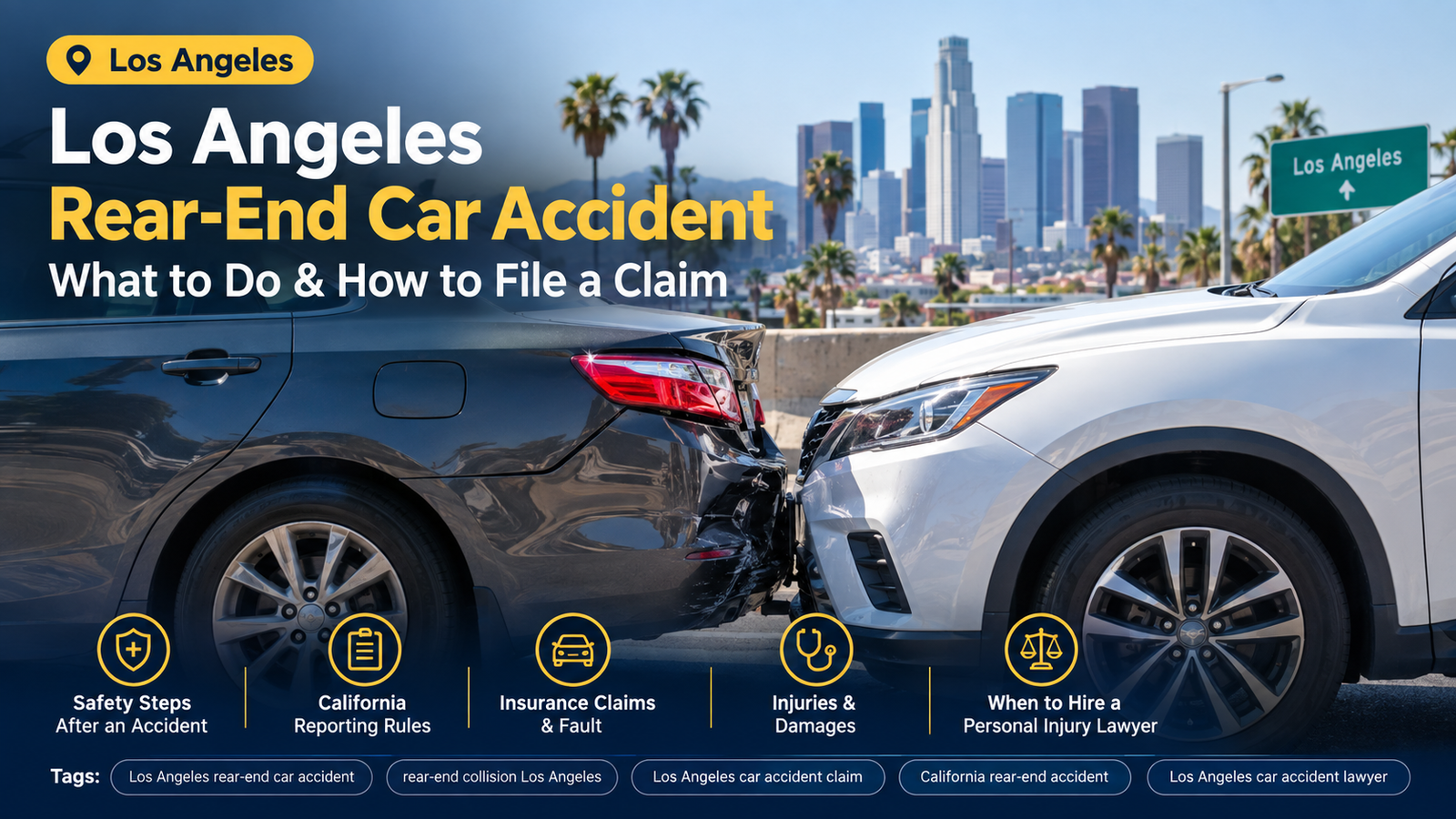

A rear-end car accident in Los Angeles can happen in seconds. You may be stopped at a traffic light, slowing down on a busy road, sitting in traffic on a freeway, or waiting for another vehicle to move when another driver suddenly crashes into the back of your car.
Although rear-end collisions are common, they are not always simple from a legal or insurance perspective. A crash can leave you dealing with vehicle repairs, medical treatment, lost income, insurance adjusters, and questions about who was responsible.
If you were injured in a Los Angeles rear-end car accident, understanding what to do after the collision can help you protect important evidence and make informed decisions about your claim.
This guide explains the steps to take after a rear-end collision, common causes and injuries, California accident-reporting requirements, insurance claims, potential damages, comparative fault, and when legal assistance may be worth considering.
Legal information disclaimer: This article is for general educational and informational purposes only. It is not legal advice and does not create an attorney-client relationship. California laws and deadlines can vary depending on the circumstances of a claim. For advice about a specific accident, consult a California-licensed attorney.
What Is a Rear-End Car Accident?
A rear-end car accident happens when the front of one vehicle strikes the rear of another vehicle.
In Los Angeles, these collisions can happen in many different environments, including:
- Freeways
- Busy intersections
- Stoplights
- Residential streets
- Parking lots
- Construction zones
- Stop-and-go traffic
- Highway entrance and exit ramps
A rear-end collision may involve only two vehicles, but some crashes become chain-reaction accidents involving three or more vehicles.
For example, Driver A may stop suddenly, Driver B may hit Driver A, and Driver C may then crash into Driver B. In that situation, determining responsibility may require examining the actions of each driver rather than automatically blaming the last vehicle in the chain.
Why Are Rear-End Accidents Common in Los Angeles?
Los Angeles is known for heavy traffic, frequent congestion, and large numbers of vehicles traveling through the region.
Traffic conditions can require drivers to repeatedly accelerate, slow down, and stop. A moment of distraction or insufficient following distance can therefore lead to a collision.
Common contributing factors may include:
- Distracted driving
- Following too closely
- Speeding
- Sudden braking
- Driver fatigue
- Impaired driving
- Unsafe lane changes
- Heavy congestion
- Poor visibility
- Road construction
- Unexpected traffic conditions
The specific cause of a collision should be determined from the available evidence rather than assumed immediately after the crash.
What Should You Do After a Rear-End Accident in Los Angeles?
Your actions after a crash can affect both your health and your ability to document what happened.
1. Check for Injuries
First, check yourself and your passengers for injuries.
Some injuries may be obvious immediately, while others may become noticeable later.
If someone has a serious injury or needs emergency assistance, call 911.
2. Move to a Safe Location When Possible
A damaged vehicle sitting in an active traffic lane can create an additional collision risk.
If the vehicle can be moved safely and circumstances permit, move it to a safer location.
Do not put yourself or others at additional risk just to move a damaged vehicle.
3. Contact Law Enforcement When Appropriate
Depending on the circumstances, contacting law enforcement can help document the collision.
A police or CHP report may contain information about:
- The location of the crash
- Vehicles involved
- Driver statements
- Witness information
- Road conditions
- Officer observations
- Citations or suspected violations
A report is evidence, but it does not necessarily resolve every question about civil liability.
4. Exchange Information With the Other Driver
Collect the relevant information from the other driver, including:
- Full name
- Driver’s license information
- Contact information
- Vehicle information
- License plate number
- Insurance company
- Insurance policy information
If multiple vehicles were involved, collect information from the other involved drivers when it is safe.
5. Photograph the Accident Scene
If you can safely do so, take photographs before the vehicles or scene change.
Useful photographs may include:
- Rear damage to your vehicle
- Front damage to the other vehicle
- Vehicle positions
- Traffic signals
- Road signs
- Lane markings
- Debris
- Skid marks
- Visible injuries
- Nearby road conditions
Take both close-up and wider photographs.
6. Identify Witnesses
Independent witnesses can potentially provide useful information about how the collision occurred.
If someone witnessed the accident, consider recording:
- Name
- Phone number
- Email address
- Basic description of what they saw
Do not ask a witness to change or exaggerate their account. Independent observations are more useful than coached statements.
California SR-1 Reporting Requirement After an Accident
California has a separate DMV reporting requirement for certain traffic collisions.
According to the California DMV, a driver must submit a Report of Traffic Accident Occurring in California (SR-1) within 10 days when the accident results in an injury or death, or when property damage exceeds $1,000. The report is required in addition to reports made to law enforcement, CHP, or an insurance company.
Importantly, the DMV states that the SR-1 requirement applies regardless of who caused the collision.
This means you should not assume that filing a police report or notifying your insurance company automatically satisfies the DMV reporting requirement.
The official California DMV guidance should be checked for the current reporting process and requirements.
Common Causes of Los Angeles Rear-End Collisions
Distracted Driving
Distracted driving can prevent a driver from noticing that traffic has slowed or stopped.
Common distractions may include:
- Cell phones
- Text messages
- Navigation systems
- Eating
- Passengers
- Adjusting vehicle controls
A driver who looks away from traffic for only a few seconds may fail to react in time.
Following Too Closely
Following too closely reduces the amount of time available to respond when the vehicle ahead slows down.
A safe following distance gives a driver more time to react to changing traffic conditions.
Speeding
Speed can affect both stopping distance and crash severity.
A driver traveling too fast may not have enough time or distance to stop before striking a vehicle ahead.
Sudden Traffic Stops
Los Angeles traffic can change quickly.
Traffic may suddenly slow because of:
- Congestion
- Construction
- An accident
- Emergency vehicles
- Road debris
- A vehicle entering traffic
Drivers need to remain attentive to changing conditions.
Fatigued Driving
Driver fatigue may affect attention, reaction time, and decision-making.
A tired driver may fail to recognize that vehicles ahead have stopped.
Impaired Driving
Alcohol or drug impairment can affect judgment, coordination, attention, and reaction time.
If impairment is suspected, the police investigation may become particularly important.
Common Injuries After a Rear-End Accident
Rear-end collisions can cause different types of injuries.
Common injuries include:
- Whiplash
- Neck pain
- Back injuries
- Shoulder injuries
- Head injuries
- Concussions
- Soft-tissue injuries
- Spinal injuries
- Fractures
- Nerve injuries
The severity of an injury depends on many factors, including the force and direction of the impact, vehicle characteristics, occupant position, seat-belt use, and individual circumstances.
Whiplash
Whiplash is commonly associated with rear-impact collisions.
The rapid movement of the head and neck during a collision may result in symptoms such as:
- Neck pain
- Neck stiffness
- Headaches
- Shoulder pain
- Reduced range of motion
Some people may experience symptoms immediately, while others notice them later.
If you experience pain, dizziness, headaches, or other concerning symptoms after a collision, seek appropriate medical evaluation.
Can a Minor Rear-End Accident Cause Serious Injuries?
Yes.
The visible damage to a vehicle does not necessarily tell you everything about an occupant’s injuries.
A vehicle may absorb or distribute some of the crash energy, while an occupant may still experience physical symptoms.
At the same time, serious-looking vehicle damage does not automatically establish the existence or severity of a particular injury.
Medical evaluation and documentation are therefore more useful than judging an injury solely from vehicle damage.
Who Is at Fault in a Los Angeles Rear-End Accident?
Many people assume that the driver who hits the vehicle in front is automatically responsible.
That assumption can be too simplistic.
The driver who rear-ends another vehicle may be found responsible if the evidence establishes negligence, such as following too closely, failing to pay attention, or failing to respond appropriately to traffic conditions.
However, other facts may affect the analysis.
For example:
The Front Vehicle Reversed
If the vehicle in front suddenly moved backward into another vehicle, the circumstances could be different from a conventional rear-end collision.
Brake Lights Were Defective
A malfunctioning brake-light system could become relevant depending on the facts.
Another Vehicle Caused the Collision
A third vehicle may force one car into another.
Multiple Vehicles Were Involved
Chain-reaction collisions can involve several drivers and potentially different degrees of responsibility.
Road Conditions Contributed
Construction, debris, poor visibility, or other road conditions may become relevant to the investigation.
The available evidence and applicable California law should therefore be considered before assigning fault.
California Comparative Fault and Rear-End Accidents
California recognizes comparative-fault principles in personal injury cases.
This means that if more than one party is found responsible, the allocation of fault can affect the amount of damages that may be recovered.
California’s statutory framework also distinguishes between economic and non-economic damages and addresses liability in cases involving comparative fault.
For example, evidence may raise questions about whether:
- The following driver was traveling too fast
- The front driver stopped unexpectedly
- Another vehicle caused a chain reaction
- A vehicle had defective equipment
- More than one driver contributed to the crash
Because the application of comparative fault depends on the facts and applicable law, an injured person should not assume that being partially blamed automatically eliminates a potential claim.
What Evidence Can Help With a Los Angeles Rear-End Accident Claim?
Evidence can be particularly important when the drivers disagree about what happened.
Police or Collision Reports
Official reports may provide information about the scene and investigation.
Photographs
Photographs can preserve:
- Vehicle damage
- Road conditions
- Traffic signals
- Lane positions
- Debris
- Visible injuries
Dashcam Video
Dashcam footage may provide a direct record of the moments before and during a collision.
Surveillance Video
Businesses, buildings, parking facilities, or traffic systems may have cameras near an accident location.
If you know a camera may have captured the crash, identifying the source quickly can be useful because recordings may not be stored indefinitely.
Witness Statements
Independent witnesses may help establish what happened immediately before the collision.
Medical Records
Medical records can document diagnosis, treatment, prescriptions, rehabilitation, and follow-up care.
Wage Documentation
If an injury affects your ability to work, relevant documentation may help establish lost income.
How Does a Los Angeles Rear-End Accident Insurance Claim Work?
An insurance claim may involve several stages.
Step 1: Report the Accident
Notify the relevant insurance company according to your policy and applicable requirements.
Step 2: Insurance Investigation
An adjuster may review:
- Statements
- Police reports
- Photographs
- Vehicle damage
- Medical information
- Witness accounts
- Other available evidence
Step 3: Liability Evaluation
The insurer may determine whether it believes its insured is responsible for the accident.
Step 4: Damage Evaluation
If an injury claim is involved, the evaluation may consider documented losses such as medical expenses and lost income, along with other damages permitted by applicable law.
Step 5: Settlement Discussions
The parties may exchange information and negotiate.
Step 6: Resolution
A claim may resolve through settlement, but some disputes may ultimately require litigation.
What Damages Can You Potentially Recover?
The damages available in a particular case depend on the facts and applicable California law.
Potential categories may include:
Medical Expenses
These can include accident-related medical treatment and, when legally recoverable and supported by evidence, future medical needs.
Lost Income
If an injury prevents someone from working, documented lost wages may be relevant.
Reduced Earning Capacity
A serious injury may potentially affect future ability to earn income.
Property Damage
Vehicle repair or replacement costs may be relevant to a property-damage claim.
Pain and Suffering
California law recognizes non-economic losses such as pain and suffering in appropriate personal injury cases.
There is no single formula that guarantees a particular settlement amount.
How Much Is a Los Angeles Rear-End Accident Claim Worth?
There is no universal settlement amount for a Los Angeles rear-end accident.
Potential claim value can depend on:
- Injury severity
- Medical expenses
- Future treatment
- Lost wages
- Future earning losses
- Permanent impairment
- Pain and suffering
- Property damage
- Insurance coverage
- Liability
- Comparative fault
- Strength of evidence
Personal Injury Lawyer HQ’s existing How Much Is a Car Accident Worth in 2026? Settlement Guide explains these factors in greater detail.
For an educational estimate, readers can also use the site’s Car Accident Settlement Calculator. The calculator specifically includes rear-end collisions and asks about medical expenses, lost wages, property damage, injury severity, fault, and insurance-related information. It also states that its output is an educational estimate rather than a prediction of an actual legal recovery.
What If the Other Driver Does Not Have Enough Insurance?
A rear-end collision can become more complicated when the at-fault driver’s insurance coverage is insufficient.
Depending on the circumstances and your policy, potentially relevant coverage may include:
- Uninsured motorist coverage
- Underinsured motorist coverage
- Medical payments coverage
- Other applicable insurance benefits
The availability and application of coverage depend on the insurance policy, accident circumstances, and California law.
Reviewing the actual policy language can therefore be important.
What If the Insurance Company Denies Your Claim?
An insurance company may dispute a claim for different reasons.
For example, it may dispute:
- Who caused the accident
- Whether the accident caused the claimed injury
- The severity of an injury
- The amount of damages
- Whether particular treatment was necessary
- Whether the policy provides coverage
If a claim is denied, keep the denial letter and supporting documents.
Do not destroy photographs, medical records, bills, correspondence, repair estimates, or other evidence.
For significant injuries or disputed liability, consider speaking with a California-licensed personal injury attorney.
Common Mistakes After a Los Angeles Rear-End Accident
1. Assuming You Are Fine Because You Feel Fine Immediately
Some symptoms may not be obvious immediately after a collision.
2. Failing to Document the Scene
Evidence can disappear or become harder to obtain.
3. Admitting Fault Without Knowing All the Facts
After an accident, emotions can be high.
Stick to accurate facts and avoid guessing.
4. Giving Inaccurate Information to an Insurance Company
Always provide truthful information.
If you do not know an answer, do not invent one.
5. Posting Detailed Accident Information Online
Social-media posts, photographs, or comments can potentially become relevant in a dispute.
6. Accepting a Settlement Without Understanding the Terms
Before signing a settlement agreement, understand what claims and damages it resolves.
7. Ignoring California Reporting Requirements
If the collision meets California’s reporting criteria, remember that the DMV SR-1 requirement is separate from reports made to law enforcement or insurers.
When Should You Consider Speaking With a Los Angeles Personal Injury Attorney?
You may want to consider legal advice if:
- You suffered serious injuries
- You need surgery
- Your injury may be permanent
- You cannot work
- Medical expenses are substantial
- The other driver disputes responsibility
- Multiple vehicles were involved
- The other driver is uninsured
- The insurance company denied your claim
- The insurance company disputes your injuries
- You received a settlement offer and are unsure about its terms
If you are researching attorneys, our existing Best Personal Injury Lawyer in Los Angeles guide provides information about factors to compare, including California licensing, relevant experience, fees, communication, and case fit. It is presented as an informational comparison rather than a ranking or endorsement.
How to Choose a Los Angeles Personal Injury Attorney
If you decide to consult an attorney, consider asking:
Does the Attorney Handle Car Accident Cases?
Personal injury law covers many different types of claims.
Experience with vehicle collisions can be relevant when evaluating a rear-end accident.
Is the Attorney Licensed in California?
The California State Bar provides an official attorney search that can be used to verify licensing information.
How Does the Fee Agreement Work?
Ask about:
- Attorney fees
- Case expenses
- Expert costs
- Litigation costs
- What happens if there is no recovery
Get the fee arrangement in writing.
Who Will Handle the Case?
Ask whether the attorney or another member of the legal team will handle communication and case preparation.
Frequently Asked Questions About Los Angeles Rear-End Accidents
Is the driver who rear-ends someone automatically at fault in California?
Not necessarily. The circumstances of the collision and applicable California law determine responsibility. Evidence may show that another driver or multiple parties contributed to the accident.
What should I do after being rear-ended in Los Angeles?
Get to a safe location, check for injuries, contact emergency services when appropriate, exchange information, document the accident, identify witnesses, notify the appropriate insurers, and seek medical attention if you have symptoms or injuries.
Do I have to file an SR-1 after a rear-end accident?
California DMV states that an SR-1 is required within 10 days when a qualifying collision involves an injury or death or property damage over $1,000. The requirement applies regardless of fault and is separate from reports made to police or an insurance company.
Can I make a claim if I was partially at fault?
Potentially. California applies comparative-fault principles, so the effect of your own responsibility depends on the circumstances and applicable law.
Can whiplash qualify for a car accident claim?
Potentially. Whether an injury supports a claim depends on the medical evidence, causation, liability, damages, insurance coverage, and applicable law.
How much is a rear-end accident worth in Los Angeles?
There is no guaranteed amount. Claim value can depend on injury severity, treatment, lost income, property damage, pain and suffering, liability, comparative fault, insurance coverage, and evidence.
What evidence should I collect after a rear-end collision?
Photographs, videos, witness information, police or collision reports, medical records, vehicle repair documentation, insurance correspondence, and wage-loss records may all be relevant.
What if the other driver does not have insurance?
Depending on the circumstances and your policy, uninsured or underinsured motorist coverage may potentially apply. Review your policy and consider obtaining professional advice about your situation.
Should I accept the first insurance settlement offer?
Do not assume that the first offer represents the full value of a claim. Before accepting a settlement, understand what damages it covers and whether signing the agreement releases additional claims.
Can I calculate my potential settlement online?
You can obtain an educational estimate using a calculator, but an online calculator cannot determine the actual value of a legal claim. Personal Injury Lawyer HQ’s Car Accident Settlement Calculator specifically includes rear-end collisions among its accident types.
Final Thoughts
A Los Angeles rear-end car accident may appear straightforward, but determining responsibility and the potential value of an injury claim can involve many different factors.
After a collision, prioritize safety and medical care. Preserve evidence, document the accident, keep your medical and financial records organized, and understand your insurance obligations.
California also has specific DMV accident-reporting requirements. For qualifying crashes involving injury, death, or more than $1,000 in property damage, the California DMV states that an SR-1 must be submitted within 10 days, regardless of who caused the collision.
For more information about potential claim value, read our How Much Is a Car Accident Worth in 2026? Settlement Guide.
You can also use the Car Accident Settlement Calculator for an educational starting point.
If you suffered serious injuries or your liability or insurance claim is disputed, consider speaking with a California-licensed attorney about your individual circumstances.
