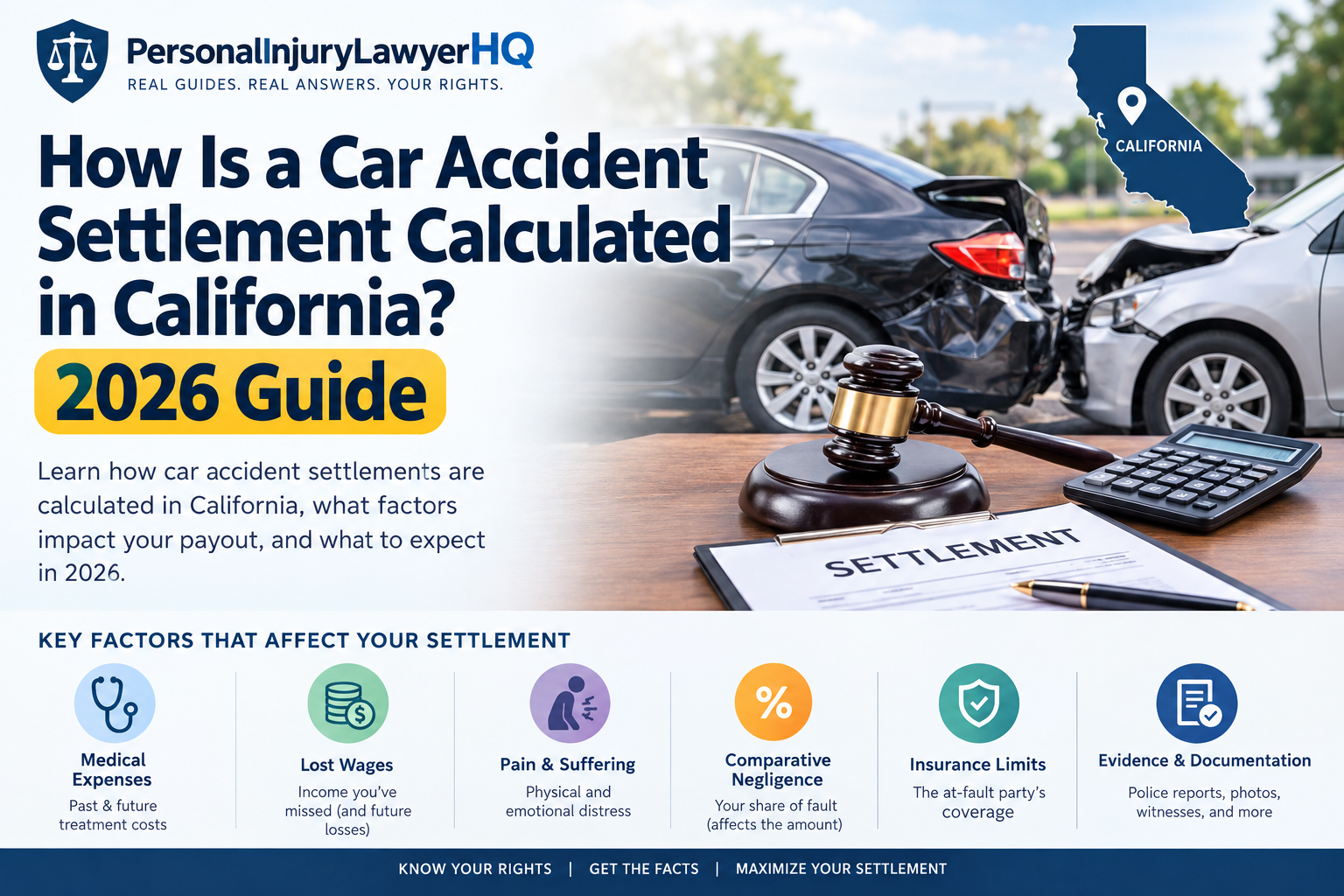

How Is a Car Accident Settlement Calculated in California?
If you have been injured in a car accident in California, one of the first questions you may have is: How much could my car accident claim be worth?
There is no single California formula that guarantees a particular settlement amount. The potential value of a claim depends on factors such as medical expenses, lost income, property damage, the nature and duration of the injuries, future losses, evidence supporting the claim, available insurance coverage, and each party’s share of fault.
California Courts explains that personal injury claims can involve compensation for medical bills, lost wages, emotional harm, and other losses caused by an injury.
This guide explains the major components that can affect a California car accident settlement and shows how an estimate can be approached using documented damages and case-specific factors.
Important: This article is for general educational information and is not legal advice. Actual claim values vary significantly based on the facts, applicable law, insurance coverage, evidence, and other circumstances.
How Is a California Car Accident Settlement Calculated?
A simplified educational model can be expressed as:
Potential claim value = Economic damages + Non-economic damages − applicable reductions or adjustments
However, this should not be treated as a guaranteed legal formula.
Economic damages are generally losses that can be documented with financial records. California law defines economic damages to include objectively verifiable monetary losses such as medical expenses and loss of earnings. Non-economic damages include losses such as pain, suffering, mental suffering, and emotional distress.
For a real claim, additional issues can affect the amount that can actually be recovered, including comparative fault, insurance policy limits, disputed liability, future damages, and evidence.
What Are Economic Damages in a California Car Accident?
Economic damages are the financial losses that can generally be supported through documentation.
1. Medical Expenses
Medical expenses can be one of the most important components of a personal injury claim.
Depending on the circumstances, documentation may include:
- Emergency room bills
- Ambulance expenses
- Doctor visits
- Hospital treatment
- Diagnostic imaging
- Prescription medication
- Physical therapy
- Chiropractic treatment
- Surgery
- Follow-up treatment
- Rehabilitation
- Other accident-related medical care
Keep copies of medical bills, receipts, treatment records, and other documentation connecting the treatment to the accident.
California law identifies medical expenses as an example of economic damages.
2. Future Medical Expenses
Some injuries require treatment long after the accident.
Examples can include:
- Additional surgery
- Long-term physical therapy
- Rehabilitation
- Medication
- Specialist treatment
- Medical equipment
- Ongoing psychological treatment
Future medical expenses can be more difficult to calculate because they involve estimating costs that have not yet been incurred.
For that reason, future damages generally require stronger documentation than simply adding existing medical bills.
3. Lost Wages
If an accident prevents you from working, lost income can become part of the economic damages calculation.
Potential documentation can include:
- Pay stubs
- Employer statements
- Tax records
- Employment records
- Time-off records
- Self-employment income records
- Other documentation showing lost earnings
California’s statutory definition of economic damages includes loss of earnings and loss of employment or business opportunities.
Example
Suppose someone normally earns:
$1,000 per week
and misses:
6 weeks of work
A simplified calculation would be:
$1,000 × 6 = $6,000 in lost wages
This is only an example. Actual claims may involve different calculations depending on employment status, benefits, taxes, future earning capacity, and the evidence available.
4. Loss of Earning Capacity
A serious injury can affect more than the income already lost.
For example, suppose an injured worker cannot return to the same occupation or can work only reduced hours because of a permanent injury.
The claim may involve future economic losses.
These cases can become substantially more complicated because the analysis may involve:
- Previous earnings
- Age
- Occupation
- Education
- Skills
- Career trajectory
- Physical limitations
- Expected future work
- Medical evidence
The more significant the claimed future losses, the more important detailed supporting evidence becomes.
What Are Non-Economic Damages?
Not every loss from a car accident comes with a receipt.
A person can experience pain, emotional distress, inconvenience, and other consequences that are difficult to express as a simple dollar amount.
California’s statutory definition of non-economic damages includes:
- Pain
- Suffering
- Inconvenience
- Mental suffering
- Emotional distress
- Loss of society and companionship
- Loss of consortium
- Humiliation
The amount attributed to these losses can vary substantially between cases.
How Is Pain and Suffering Calculated?
There is no universal California settlement number for pain and suffering.
Two commonly discussed approaches are the multiplier approach and the per-diem approach, but neither should be treated as an automatic California legal formula.
Multiplier approach
An informal calculation may look like:
Economic damages × multiplier = estimated non-economic damages
For example, if documented economic damages were $20,000, an illustrative multiplier of 2 would produce:
$20,000 × 2 = $40,000
The example is only mathematical illustration—not a prediction of what a California claim should settle for.
Factors that may affect the assessment of non-economic harm include:
- Severity of injury
- Duration of symptoms
- Medical treatment
- Surgery
- Permanent impairment
- Scarring
- Limitations on daily activities
- Emotional consequences
- Recovery time
- Quality of supporting evidence
Per-diem approach
Another approach sometimes discussed in personal injury negotiations assigns a daily value to pain and suffering for a particular period.
Again, this is an estimation method rather than a guaranteed California settlement formula.
How Does Comparative Fault Affect a California Settlement?
This is one of the most important California-specific issues.
California follows a pure comparative negligence system. The California Supreme Court adopted the rule in Li v. Yellow Cab Co., holding that an injured person’s recovery is reduced in proportion to that person’s negligence rather than automatically barred because the person contributed to the accident.
Simple example
Imagine a claim with:
$100,000 in damages
and the injured person is determined to be:
20% at fault
A simplified proportional calculation would be:
$100,000 × 80% = $80,000
The example illustrates the effect of comparative fault. Actual liability and damages can involve more complicated factual and legal questions.
This is why determining who caused the accident and how fault is allocated can be just as important as calculating medical bills.
What Evidence Can Affect the Settlement Calculation?
The strength of the evidence can have a major impact on how an insurance company or opposing party evaluates a claim.
Useful evidence may include:
Accident evidence
- Police reports
- Photographs
- Dashcam footage
- Traffic-camera footage where available
- Vehicle damage photographs
- Witness information
- Accident scene photographs
Medical evidence
- Medical records
- Medical bills
- Diagnostic reports
- Treatment plans
- Physician opinions
- Rehabilitation records
Employment evidence
- Pay stubs
- Employer verification
- Tax records
- Work schedules
- Documentation of missed work
Other evidence
- Photos of injuries
- Journal or diary documenting symptoms
- Communications with insurers
- Repair estimates
- Property damage documentation
The goal is to establish a clear connection between the accident, the injury, and the claimed losses.
How Do Insurance Policy Limits Affect a Settlement?
Insurance coverage can be an important practical limitation on recovery.
California’s Department of Insurance states that, beginning in 2025, standard auto insurance minimum liability limits increased to:
- $30,000 for bodily injury or death per person
- $60,000 for bodily injury or death per accident
- $15,000 for property damage per accident
However, a particular driver’s policy may provide higher limits.
California Department of Insurance materials also show that policies can carry substantially higher coverage limits than the minimum required limits.
This means the amount of insurance available can matter when evaluating a potential claim.
For example, a serious injury claim could theoretically involve damages greater than the at-fault driver’s liability policy limit. In that situation, additional questions about available coverage, assets, other potentially responsible parties, or applicable insurance policies may become relevant.
What If the Other Driver Has Little or No Insurance?
A claim does not necessarily end simply because the at-fault driver has limited insurance.
Depending on the circumstances, an injured person may need to investigate:
- Uninsured motorist coverage
- Underinsured motorist coverage
- Multiple insurance policies
- Additional potentially responsible parties
- Other sources of compensation
The exact availability of these options depends on the insurance policies and facts of the accident.
How Does Property Damage Fit Into the Calculation?
A car accident can produce both personal injury and property damage.
Property-related losses may include:
- Vehicle repair costs
- Vehicle replacement costs
- Towing
- Storage
- Rental transportation
- Damaged personal property
California Courts distinguishes personal injury and property damage claims and notes that property damage generally has a different statute of limitations from personal injury.
Keep repair estimates, invoices, photographs, towing bills, rental-car documentation, and other records.
Does the Severity of the Injury Affect Settlement Value?
Generally, the nature and consequences of an injury can substantially affect the losses being claimed.
For example, a case involving a short period of treatment may involve very different damages from one involving:
- Surgery
- Permanent impairment
- Long-term rehabilitation
- Significant scarring
- Chronic symptoms
- Long-term work restrictions
But an injury label alone does not determine a settlement amount.
For example, two people can both have a diagnosis of whiplash while having very different medical treatment, recovery periods, work losses, and documented damages.
That is why settlement analysis should focus on the actual facts and documented consequences, rather than relying only on an injury category.
How Does the Insurance Company Evaluate a Car Accident Claim?
An insurance company may review factors such as:
- Who was responsible for the accident?
- What evidence supports liability?
- What injuries were diagnosed?
- What treatment was received?
- What medical expenses were incurred?
- Was income lost?
- Are future losses claimed?
- How much insurance coverage is available?
- Is comparative fault disputed?
- How well are the claimed damages documented?
This is one reason why simply adding medical bills does not necessarily produce a reliable settlement estimate.
Example of a Simplified California Settlement Calculation
Consider this hypothetical example.
A driver suffers an injury in a collision.
Economic damages
Medical expenses:
$18,000
Lost wages:
$7,000
Property damage:
$10,000
Total documented economic losses:
$35,000
Suppose, purely for illustration, an evaluator considered an additional:
$30,000
in non-economic damages.
That would produce:
$35,000 + $30,000 = $65,000
Now suppose the injured person were determined to be 10% responsible for the accident.
A simplified proportional calculation would be:
$65,000 × 90% = $58,500
This is not a prediction of a $58,500 settlement.
It simply demonstrates how economic damages, non-economic damages, and comparative fault can interact.
Actual cases can involve disputed liability, different damage categories, insurance limits, medical liens, multiple parties, and other issues.
Use a Car Accident Settlement Calculator
If you want an initial educational estimate, you can enter your accident information into our:
Car Accident Settlement Calculator
The calculator can help organize factors such as:
- Medical expenses
- Future medical expenses
- Lost wages
- Future lost income
- Property damage
- Injury severity
- Surgery
- Permanent injury
- Other expenses
- Fault-related adjustments
Important: A calculator estimate is not a guarantee of what an insurance company, judge, or jury would award.
For a more useful estimate, gather your medical bills, wage-loss information, insurance details, accident evidence, and other documentation before entering the information.
California Car Accident Settlement: Factors That Matter Most
When evaluating a potential claim, the following factors can be particularly important:
| Factor | Why it matters |
|---|---|
| Medical expenses | Helps document financial losses |
| Future treatment | Can increase potential future economic damages |
| Lost wages | Documents income already lost |
| Earning capacity | May matter when injuries affect future work |
| Pain and suffering | Addresses non-economic harm |
| Permanent impairment | Can affect future losses and non-economic damages |
| Liability | Determines whether another party may be responsible |
| Comparative fault | Can reduce recovery based on the claimant’s share of fault |
| Insurance limits | Can affect the practical amount available from insurance |
| Evidence | Supports liability and damages |
| Treatment consistency | Helps establish the nature and duration of injuries |
| Property damage | Documents accident-related vehicle/property losses |
How Long Do You Have to File a California Car Accident Lawsuit?
California Courts states that the general statute of limitations for a personal injury case is two years from the date of injury, although exceptions and different rules can apply depending on the circumstances.
California Courts also notes that claims involving the government can have shorter deadlines.
Therefore, accident victims should not assume that every California claim follows exactly the same deadline.
If you are approaching a potential filing deadline, professional legal advice may be important because missing an applicable deadline can affect your ability to pursue a claim.
Frequently Asked Questions
What is the average car accident settlement in California?
There is no single reliable average that can predict the value of an individual California car accident claim.
Settlement value depends on factors including injury severity, medical expenses, lost income, future losses, pain and suffering, liability, comparative fault, insurance coverage, and evidence.
Is there a California formula for calculating pain and suffering?
There is no universal formula that guarantees a particular amount. Multipliers and per-diem methods may be used as valuation approaches, but actual claims depend on the facts and applicable law.
Does medical treatment increase a settlement?
Medical treatment can document the nature and consequences of an injury, but more treatment does not automatically mean a higher settlement. Treatment should be medically appropriate and connected to the accident.
What if I was partly at fault?
California follows pure comparative negligence. Under the rule established in Li v. Yellow Cab Co., damages can be reduced according to the claimant’s share of negligence rather than automatically eliminating recovery.
Do insurance policy limits matter?
Yes. Available insurance coverage can be an important practical factor in a claim. California’s standard minimum auto liability limits have been $30,000/$60,000/$15,000 since 2025.
Can I claim future medical expenses?
Potential future medical losses may be relevant when an injury requires future treatment. The amount generally depends on the evidence supporting the anticipated treatment and cost.
Can I claim lost wages?
Lost earnings may be part of economic damages when supported by appropriate documentation. California’s statutory definition of economic damages includes loss of earnings.
How long do I have to sue after a California car accident?
California Courts generally lists two years from the injury for personal injury lawsuits, but exceptions and special rules can apply. Claims involving government entities can have different deadlines.
Final Takeaway
A California car accident settlement is not determined by one simple multiplier or a fixed statewide dollar amount.
A more useful way to understand potential claim value is to examine:
Economic damages + non-economic harm + future losses + liability + insurance coverage − applicable fault/reductions
The strongest evaluation starts with accurate documentation.
If you have been involved in an accident, organize your medical records, bills, wage-loss documents, accident evidence, insurance information, and property-damage records.
You can then use our Car Accident Settlement Calculator for an educational estimate and explore our other California car accident resources for additional information.
Related resources:
- Car Accident Settlement Calculator
- How Much Is a Car Accident Worth?
- Los Angeles Rear-End Car Accident
- What to Do After an Accident
Sources: California Courts, California Legislature, California Department of Insurance, and California Supreme Court case law cited throughout this article.
