If you’ve been injured because of someone else’s negligence, one of the first questions that probably comes to mind is simple: How much is my personal injury claim worth?
Unfortunately, there isn’t one fixed number that applies to every accident.
Two people can be involved in similar accidents and receive completely different settlements. The final value of a personal injury claim can depend on the severity of the injury, medical expenses, lost income, insurance coverage, long-term effects, liability, and several other factors.
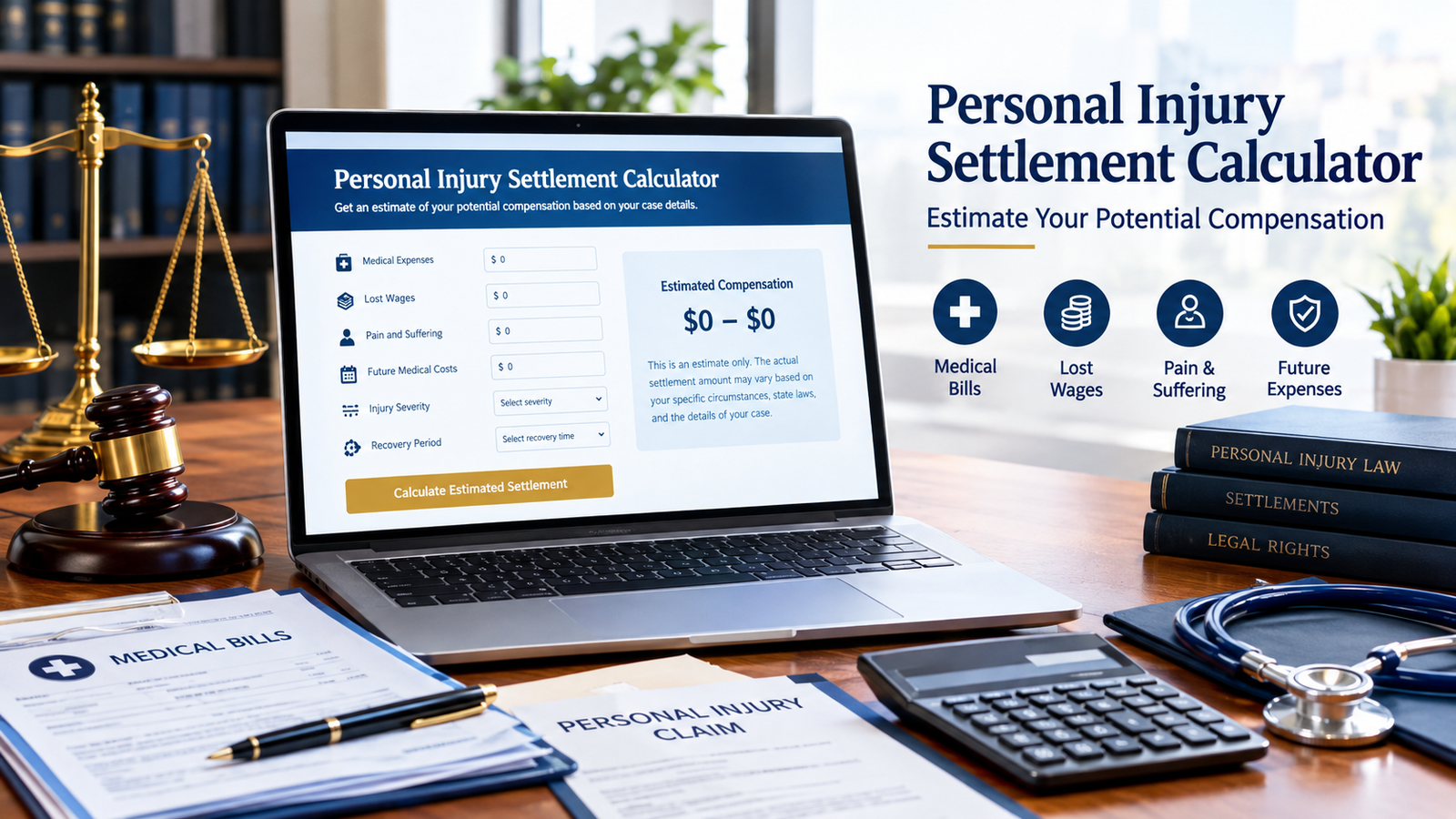
A personal injury settlement calculator can help you create a starting estimate by considering some of the financial and non-economic losses associated with an injury.
However, an online calculator is only an estimate. It cannot replace an evaluation by a qualified personal injury attorney who understands the laws and insurance rules in the state where your accident occurred.
What Is a Personal Injury Settlement?
A personal injury settlement is an agreement in which an injured person receives compensation from the responsible party or an insurance company in exchange for resolving the claim.
Many personal injury cases are resolved through settlement negotiations rather than going all the way to trial.
Depending on the circumstances, compensation may potentially include:
- Medical expenses
- Future medical treatment
- Lost wages
- Reduced future earning capacity
- Property damage
- Physical pain
- Emotional distress
- Loss of enjoyment of life
- Permanent disability or impairment
- Other accident-related losses
The exact damages available depend on the facts of the case and the applicable state law.
How Does a Personal Injury Settlement Calculator Work?
A settlement calculator generally uses information about your financial losses and the impact of your injury to produce an estimated range.
For example, you may be asked to enter:
- Total medical expenses
- Lost income
- Estimated future medical costs
- Severity of the injury
- Whether you experienced permanent impairment
- Information about pain and suffering
- Insurance coverage
- Other economic losses
The calculator may then use these inputs to provide an estimated settlement value.
It is important to understand that this number is not a guaranteed settlement offer.
Example
Imagine someone has:
- $20,000 in medical expenses
- $8,000 in lost wages
- $5,000 in additional accident-related expenses
Their documented economic losses would be approximately $33,000.
But the potential value of a claim may be higher than the economic losses alone if the person also experienced significant pain, emotional distress, permanent limitations, or other compensable damages.
This is why simply adding medical bills and lost wages does not always tell the complete story.
What Factors Affect a Personal Injury Settlement?
Several factors can influence the value of an injury claim.
1. Severity of Your Injuries
The seriousness of the injury is often one of the most important factors.
A minor soft-tissue injury that heals within a few weeks may have a very different value from a traumatic brain injury, spinal cord injury, fracture, or permanent disability.
Generally, injuries requiring extensive treatment or creating long-term limitations can involve significantly greater damages.
2. Medical Expenses
Medical bills provide important evidence of the financial impact of an accident.
Depending on the circumstances, expenses may include:
- Emergency room treatment
- Hospitalization
- Surgery
- Doctor visits
- Prescription medication
- Physical therapy
- Diagnostic testing
- Rehabilitation
- Mental health treatment
- Future medical care
Keep copies of medical records and bills associated with your accident.
3. Lost Wages
An injury can affect more than your health.
If you miss work because of an accident, you may experience lost income. In more serious cases, an injury can affect your ability to perform the same job or earn the same income in the future.
Documentation such as pay stubs, employer records, tax documents, and employment records may help demonstrate lost income.
4. Pain and Suffering
Pain and suffering is different from a medical bill because it involves the physical and emotional impact of an injury.
Examples may include:
- Physical pain
- Anxiety
- Emotional distress
- Sleep problems
- Reduced mobility
- Loss of enjoyment of normal activities
- Fear or psychological effects following an accident
There is no universal formula that accurately determines pain and suffering in every case.
Some insurance companies and lawyers may use different approaches when evaluating these damages.
5. Permanent Disability or Impairment
A permanent injury can substantially affect the value of a personal injury claim.
For example, someone who suffers a permanent limitation that affects work, mobility, or everyday activities may have damages extending far beyond their initial medical bills.
Future medical care and reduced earning capacity may also become important parts of the claim.
6. Liability
Even a serious injury does not automatically mean the other party is legally responsible.
You generally need evidence showing that another party was legally responsible for causing your injury.
Depending on the case, evidence may include:
- Police reports
- Accident photographs
- Surveillance footage
- Witness statements
- Medical records
- Expert opinions
- Vehicle damage
- Accident reconstruction evidence
- Communication with insurance companies
If fault is disputed, the value and outcome of the claim can become much more complicated.
How Is Pain and Suffering Calculated?
There is no single nationwide formula for calculating pain and suffering.
Two approaches that are sometimes discussed are the multiplier method and the per diem method.
Multiplier Method
Under a multiplier approach, economic damages may be multiplied by a number representing the seriousness of the injury.
For example, suppose economic damages are $30,000 and someone hypothetically applies a multiplier of 2.5.
$30,000 × 2.5 = $75,000
Adding the economic damages would produce a hypothetical total of $105,000.
However, this is only an illustration—not a prediction of what an actual case is worth. Insurance companies, attorneys, courts, and state laws may treat damages differently.
Per Diem Method
Another approach assigns a daily amount to pain and suffering for a particular period.
For example, if a hypothetical value of $200 per day were used for 180 days:
$200 × 180 = $36,000
Again, this is only a mathematical example. The actual valuation of pain and suffering depends on the circumstances and applicable law.
Does Every Personal Injury Case Have a Settlement?
No.
Some claims settle through negotiations, while others may proceed to litigation.
An insurance company may dispute:
- Who caused the accident
- Whether the injury was caused by the accident
- The seriousness of the injury
- The amount of medical expenses
- Whether treatment was necessary
- Future medical costs
- Lost income
- The amount of pain and suffering
- Available insurance coverage
If the parties cannot reach an agreement, a lawsuit may become necessary.
What Should You Do After a Personal Injury Accident?
The steps you take after an accident can affect your ability to document your claim.
Seek Medical Attention
Your health should come first.
Even if an injury initially seems minor, some conditions may not become obvious immediately. Follow appropriate medical advice and keep records of your treatment.
Document the Accident
If possible, preserve evidence such as:
- Photos of the accident scene
- Photos of visible injuries
- Vehicle or property damage
- Witness information
- Police reports
- Medical records
- Receipts
- Lost wage documentation
Be Careful With Insurance Adjusters
An insurance adjuster may ask questions about the accident or your injuries.
You should provide truthful information, but avoid guessing or minimizing your injuries.
Do not assume that the first settlement offer represents the full value of your claim.
Keep a Personal Injury File
Create a folder containing all relevant documentation.
Organizing your records can make it easier to understand your losses and communicate with an attorney or insurance company.
How Long Do You Have to File a Personal Injury Claim?
This is one of the most important questions after an accident.
The deadline for filing a personal injury lawsuit is generally controlled by a state’s statute of limitations, and the deadline can vary significantly depending on the state and type of claim. Missing the applicable deadline can seriously affect your ability to pursue compensation.
For example, many states use a two-year period for certain personal injury claims, while others provide different deadlines. Exceptions can also apply depending on factors such as the defendant, type of injury, discovery rules, minors, or government defendants.
Because deadlines are state-specific, do not rely on a generic online calculator to determine your legal deadline.
If you believe you have a claim, check the applicable law or speak with a licensed attorney as soon as possible.
Can You Still Receive Compensation If You Were Partially at Fault?
Possibly.
Many states use some form of comparative-fault system, but the rules differ from state to state.
Depending on the jurisdiction, your compensation may be reduced according to your percentage of fault, and in some states a person’s level of fault can affect whether they recover anything at all.
For this reason, determining liability is an important part of evaluating a personal injury claim.
What Is the Average Personal Injury Settlement?
There is no reliable single “average” settlement that applies to every personal injury case.
A settlement can range from relatively modest amounts to very substantial compensation depending on the circumstances.
For example, a case involving minor injuries and short-term treatment may be worth considerably less than a claim involving surgery, permanent disability, substantial lost income, and long-term medical care.
Instead of focusing only on an average settlement figure, it is usually more useful to consider:
- Your actual medical expenses
- Your lost income
- Future financial losses
- Severity of your injuries
- Duration of treatment
- Permanent impairment
- Liability
- Available insurance coverage
- Evidence supporting the claim
Why Insurance Policy Limits Matter
Even if your damages are substantial, available insurance coverage can affect the practical amount that may be recovered from an insurer.
For example, if a responsible driver’s liability policy has a relatively low limit, collecting the full value of a much larger claim from that policy may not be possible.
Other sources of compensation may sometimes exist, depending on the circumstances and applicable law.
This is one reason why understanding the insurance coverage involved in an accident can be important.
What Documents Can Increase the Strength of Your Claim?
Strong documentation can help demonstrate both liability and damages.
Consider keeping:
- Medical bills
- Medical records
- Prescription receipts
- Pay stubs
- Tax documents
- Employer statements
- Accident reports
- Photographs
- Videos
- Witness information
- Repair estimates
- Insurance correspondence
- A personal pain or recovery journal
Your documentation should tell the story of what happened, how you were injured, and how the injury affected your life.
Personal Injury Settlement Calculator: What Should You Enter?
If you are using an online settlement calculator, accurate information is important.
You may want to have the following information available:
Medical expenses:
Add documented medical costs connected to the accident.
Lost income:
Calculate income you actually lost because of your injury.
Future losses:
Consider whether your injury may require additional treatment or affect your future earning capacity.
Injury severity:
Describe the injury as accurately as possible.
Recovery period:
Consider how long your treatment and recovery have lasted.
Permanent effects:
Include any known long-term limitations.
The more accurate your information, the more useful an online estimate can be as a starting point.
Personal Injury Settlement Calculator vs. Hiring a Lawyer
An online calculator can be useful for understanding the basic economics of a claim.
But it cannot:
- Investigate an accident
- Interview witnesses
- Review evidence
- Negotiate with an insurance company
- Determine complex liability
- Interpret state-specific laws
- File a lawsuit
- Represent you in court
A calculator is therefore best viewed as an educational tool, not a substitute for legal representation.
Frequently Asked Questions
How accurate is a personal injury settlement calculator?
A calculator can provide a rough estimate based on the information you enter, but it cannot accurately predict the outcome of every claim.
How much is my personal injury claim worth?
The value depends on factors such as medical expenses, lost income, injury severity, future damages, pain and suffering, liability, insurance coverage, and applicable state law.
Can I calculate pain and suffering?
You can create an estimate using common valuation approaches, but there is no universal formula that guarantees an accurate result.
Should I accept the insurance company’s first settlement offer?
Not necessarily. Before accepting a settlement, understand what damages it covers and whether the amount reasonably reflects your losses. Once a settlement is finalized, your ability to pursue additional compensation may be limited.
How long does a personal injury settlement take?
There is no universal timeline. Straightforward claims may resolve relatively quickly, while serious or disputed cases can take considerably longer.
Do I need a personal injury lawyer?
Not every claim requires an attorney. However, legal advice can be particularly valuable when injuries are serious, liability is disputed, damages are substantial, or an insurance company is refusing to make a fair offer.
Final Thoughts
Trying to put a dollar value on an injury can be frustrating, especially when you are still dealing with medical treatment, lost income, and the emotional impact of an accident.
A personal injury settlement calculator can give you a useful starting point by helping you organize your financial losses and understand the factors that may influence a claim.
But remember that an estimate is not a guarantee.
The actual value of a personal injury claim depends on the specific facts, evidence, applicable state laws, insurance coverage, and the nature of the injuries.
If you are dealing with a serious injury or a disputed claim, consider speaking with a licensed personal injury attorney in your state before making important decisions about settlement.
Important Disclaimer
Personal Injury Lawyer HQ is an independent informational resource and is not a law firm. The information provided on this website is for general educational purposes only and does not constitute legal advice or create an attorney-client relationship. Laws and legal deadlines vary by state and individual circumstances. For advice about your specific situation, consult a licensed attorney in the appropriate jurisdiction.