

Every year in the United States, thousands of pedestrians suffer catastrophic injuries while legally crossing streets. Despite traffic statutes in all 50 states requiring motorists to yield to pedestrians, crosswalk collisions remain among the most contested personal injury claims.
Insurance companies frequently dispute fault, claiming the pedestrian darted out, ignored the signal, or was looking at a smartphone. Retaining a dedicated crosswalk accident lawyer levels the playing field, ensuring critical evidence is preserved, driver negligence is legally proven, and you recover full financial compensation for your losses.
Pedestrian Crosswalk Accidents: Official U.S. Statistics & Safety Data
Pedestrian safety in marked and unmarked corridors is a major public safety priority across federal transportation agencies:
- Fatality Trends: Federal safety data published by the National Highway Traffic Safety Administration (NHTSA) indicates that pedestrian fatalities have reached multi-decade highs, with intersections and crossing zones representing the highest concentration of serious impacts.
- Emergency Department Admissions: According to the Centers for Disease Control and Prevention (CDC), non-fatal collisions result in over 100,000 emergency medical visits each year, frequently leaving victims with long-term motor and cognitive impairments.
- Corridor & Intersection Engineering: The Federal Highway Administration (FHWA) highlights systemic roadway risks, including inadequate pedestrian hybrid beacons (HAWK signals), poorly timed light cycles, and deficient night-time illumination.
If your accident involved a rideshare vehicle, read our detailed guide on Uber and Lyft Passenger & Pedestrian Injury Claims.
Proving Liability: The 4 Elements of Negligence in Crosswalk Cases
Under U.S. tort law, securing a financial recovery requires establishing the four essential pillars of driver negligence:
- Duty of Care: Every driver owes a legal duty to exercise reasonable care toward vulnerable road users, obeying pedestrian signals and yielding right-of-way.
- Breach of Duty: The driver violated this legal duty by texting behind the wheel, making an improper left turn, speeding, or running a red light.
- Causation: That specific violation directly caused the collision—meaning the injury was not the result of an unrelated event.
- Damages: The victim sustained actual, quantifiable losses, such as emergency surgical bills, lost income, and physical suffering.
Marked vs. Unmarked Crosswalks: Understanding Right-of-Way Laws
A frequent defense raised by auto insurers is that an accident did not occur in an official crosswalk because there were no painted white lines.
- Marked Crosswalks: Clearly visible zones marked with zebra stripes, Continental bars, or overhead pedestrian lights. Drivers must yield whenever a pedestrian is in any portion of the lane or approaching within one lane of the vehicle’s direction.
- Unmarked Crosswalks: Under most state transportation codes (such as California Vehicle Code § 21950 or New York VTL § 1151), an unmarked crosswalk legally exists at every intersection where sidewalks continue across the street at right angles. Unless an intersection displays an explicit “No Pedestrian Crossing” sign, drivers must yield to pedestrians crossing there.
Settlement Values: What Is a Crosswalk Accident Claim Worth?
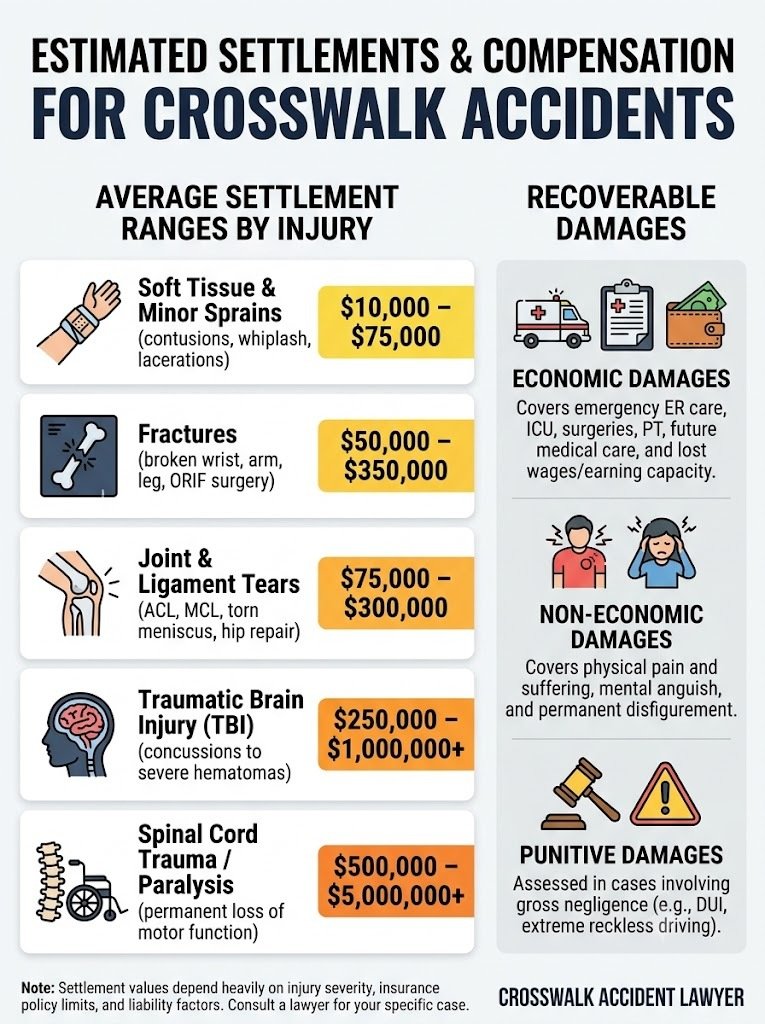
Compensation in a crosswalk injury claim depends heavily on injury severity, available insurance policy limits, and the impact of vehicle speed.
Average Settlement Ranges by Injury Category
| Injury Severity | Typical Medical Impact | Estimated Settlement Range |
| Soft Tissue & Minor Sprains | Contusions, whiplash, lacerations | $10,000 – $75,000 |
| Single Bone Fracture | Broken wrist, arm, fibula/tibia requiring casts/pins | $50,000 – $150,000 |
| Severe / Multiple Fractures | Pelvic fractures, compound leg fractures, ORIF surgery | $100,000 – $350,000 |
| Joint & Ligament Tears | ACL/MCL tears, torn meniscus, hip labrum repair | $75,000 – $300,000 |
| Traumatic Brain Injury (TBI) | Concussions to severe hematomas, cognitive deficits | $250,000 – $1,000,000+ |
| Spinal Cord Trauma / Paralysis | Permanent loss of motor function, paraplegia, quadriplegia | $500,000 – $5,000,000+ |
Recoverable Damages
- Economic Damages: Emergency ambulance fees, intensive care (ICU), physical and occupational therapy, future medical care, lost wages, and reduced future earning capacity.
- Non-Economic Damages: Pain and suffering, mental anguish, permanent disfigurement, and loss of quality of life.
- Punitive Damages: Assessed in cases involving gross negligence, such as drunk driving or extreme reckless driving.
To calculate the monetary value of your physical suffering, review our breakdown of Pain and Suffering Multiplier Methods in Injury Claims.)
Comparative Negligence: Defeating Insurer Blame-Shifting
Insurers commonly claim that the pedestrian contributed to the crash. How shared fault is handled depends on your jurisdiction’s civil code, as codified by state statutes and outlined by the Legal Information Institute at Cornell Law School:
- Pure Comparative Negligence (e.g., California, Florida): You can collect damages even if you are 90% at fault, though your settlement check is reduced by your fault share.
- Modified Comparative Negligence (e.g., Texas, Illinois): You can only recover damages if you are 50% or 51% or less at fault. If you cross that threshold, you receive nothing.
- Pure Contributory Negligence (e.g., Virginia, North Carolina, Maryland, Alabama, Washington D.C.): If the driver’s insurer proves you contributed even 1% to the incident, your recovery is barred entirely.
A personal injury attorney immediately preserves commercial video footage, traffic-cam feeds, and vehicle “black box” (EDR) data to defeat comparative negligence defenses.
5 Critical Mistakes to Avoid After a Crosswalk Crash
- Skipping the ER: Delays in seeking medical care create gaps in treatment that insurance companies use to claim your injuries were pre-existing.
- Giving a Recorded Statement: Adjusters ask leading questions to get you to say, “I didn’t see the car coming” or “I was in a hurry.” Direct all inquiries to legal counsel.
- Posting on Social Media: Insurance defense teams monitor platforms for photos or check-ins to argue that your injuries are not severe.
- Accepting a Quick Check: Early offers rarely cover upcoming surgeries, long-term rehabilitation, or lifelong loss of earnings.
- Missing Government Notice Deadlines: If struck by a city transit bus or municipal vehicle, state tort claims acts often mandate filing a formal Notice of Claim within 30 to 180 days.
How a Crosswalk Accident Lawyer Builds Your Case
Navigating the aftermath of a catastrophic pedestrian collision requires thorough preparation. When you hire an attorney, they immediately:
- Subpoena surveillance footage from intersection cameras and surrounding storefronts before it is overwritten.
- Retain accident reconstruction engineers to calculate approach speeds and sight lines.
- Cross-examine cell phone providers to prove the driver was texting or browsing at the moment of impact.
- Identify all possible insurance policies, including bodily injury coverage, commercial umbrella policies, and Underinsured Motorist (UIM) provisions.
- Negotiate with medical lienholders to reduce outstanding hospital bills, maximizing the net cash settlement you receive.
Frequently Asked Questions
What happens if the driver leaves the scene (Hit-and-Run)?
If the driver cannot be located, your lawyer will file a claim under your own automobile policy’s Uninsured Motorist (UM) bodily injury coverage. In many states, this applies even if you were walking as a pedestrian when hit.
How much does it cost to hire an attorney?
Pedestrian injury attorneys work on a contingency fee agreement. You pay zero upfront costs or hourly rates. The attorney only takes an agreed-upon percentage (usually 33.3% to 40%) from the final settlement or court verdict. If there is no recovery, you owe nothing.
What is the deadline to file a crosswalk lawsuit?
The statute of limitations varies by state, generally between 1 and 4 years from the date of injury. However, if a city government or municipal vehicle was involved, strict statutory notices must often be filed within 30 to 90 days.
Legal Disclaimer: This publication is provided for general informational purposes only and does not establish an attorney-client relationship. Pedestrian traffic laws vary by municipality and state. Consult a qualified personal injury attorney in your state for specific guidance on your case.
